
For a long time, lead generation has been one of the most recognizable ways to measure marketing success. More leads mean more opportunities, more conversations, and potentially more customers. On paper, the equation seems simple: attract prospects, generate inquiries, and help businesses grow.
But there is a problem with this approach.
What happens when a business generates hundreds of leads but struggles to convert them into paying customers?
What happens when marketing campaigns perform well, but sales teams cannot follow up consistently? Or when a company attracts new customers but lacks the operational systems, resources, and processes needed to support its growth?
These challenges reveal an important distinction: generating leads is not the same as building a successful business.
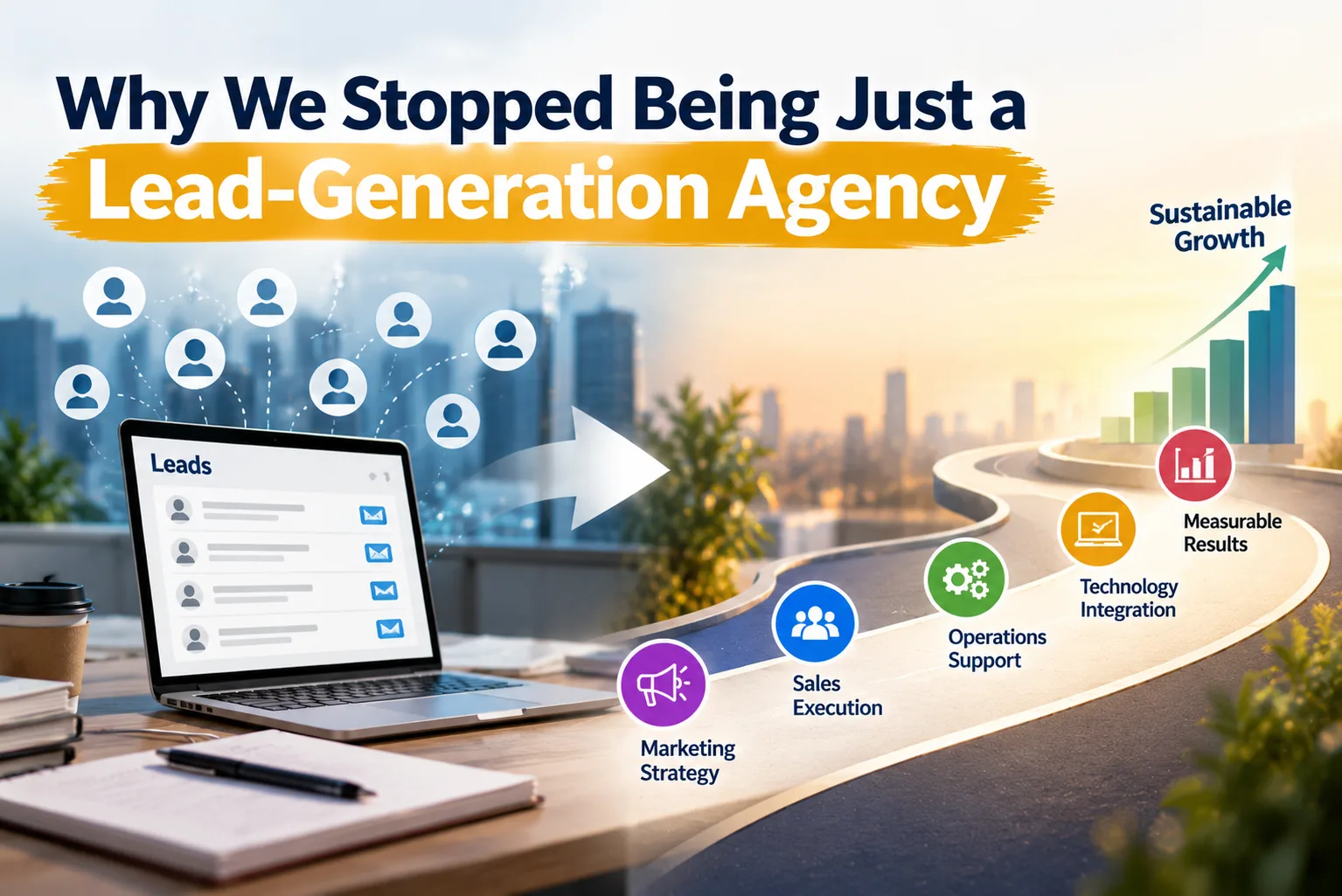
At Caprus Inc., our broader approach to business growth reflects this understanding. Rather than treating lead generation as an isolated service, we focus on connecting marketing, sales, operations, technology, and strategy to support measurable, sustainable growth.
This article explores why businesses need more than lead-generation services, what a comprehensive growth strategy looks like, and how an integrated approach can help organizations move beyond short-term acquisition goals.
Why We Stopped Being Just a Lead-Generation Agency
The title reflects a fundamental shift in how businesses should think about growth.
Lead generation remains important. Companies need a consistent flow of relevant prospects to sustain their sales pipelines. However, the value of those leads depends on what happens after they enter the business.
Imagine a company investing heavily in advertising and outreach. Its marketing team generates a steady stream of inquiries, but the sales team responds too slowly. The CRM contains outdated information, follow-ups are inconsistent, and no one knows which campaigns generate the most valuable customers.
The company may have a lead-generation problem on the surface, but the underlying issues are operational.
Generating more leads will not automatically fix those problems. In fact, it could create additional pressure on an already inefficient sales process.
This is why we believe business growth requires a broader perspective. Businesses need systems that connect demand generation with lead qualification, sales execution, customer experience, performance measurement, and operational efficiency.
The objective is not simply to create more opportunities. It is to help businesses build the capabilities required to turn opportunities into meaningful outcomes.
1. More Leads Do Not Always Mean More Revenue
One of the most common misconceptions in marketing is that increasing lead volume automatically increases revenue.
While a larger pipeline can create more opportunities, lead quality, conversion rates, sales processes, and customer value all influence the final outcome.
Consider a hypothetical example.
A business generates 200 leads in one month but converts only 2% into customers. That produces four customers.
Another business generates 100 leads but converts 8%. That produces eight customers.
The second business generates fewer leads but acquires twice as many customers.
| Performance Metric | Business A | Business B |
| Leads generated | 200 | 100 |
| Lead-to-customer conversion rate | 2% | 8% |
| Customers acquired | 4 | 8 |
Illustrative example only, not actual Caprus client results.
The lesson is straightforward: lead volume is only one part of the acquisition process.
Businesses should also evaluate lead quality, cost per qualified lead, sales conversion rate, customer acquisition cost, and revenue generated from marketing activities.
At Caprus Inc., our digital marketing approach positions demand generation within a broader growth framework, connecting visibility, engagement, and conversion rather than focusing exclusively on campaign activity.
2. The Gap Between Marketing and Sales Can Limit Growth
Marketing and sales are closely connected, yet they can operate as separate functions.
Marketing teams may focus on website traffic, advertising performance, impressions, and lead volume. Sales teams may prioritize qualified opportunities, conversations, appointments, and closed deals.
Both sets of activities matter. Problems arise when the teams work toward different objectives without a shared understanding of success.
For example, marketing may celebrate a campaign that generates a high volume of inquiries. However, the sales team may find that many prospects lack the budget, urgency, or requirements necessary to become customers.
Without feedback, marketing continues producing similar leads, and sales continues struggling to convert them.
A connected growth strategy addresses this gap through:
- Clear definitions of marketing-qualified and sales-qualified leads.
- Consistent lead qualification criteria.
- Documented follow-up processes.
- Shared performance indicators.
- CRM visibility and accurate pipeline data.
- Regular communication between marketing and sales.
- Feedback on lead quality and conversion outcomes.
When marketing and sales work together, businesses can make better decisions about targeting, messaging, campaign investment, and follow-up priorities.
This is one reason lead generation should be part of a complete customer acquisition strategy rather than a standalone objective.
3. Lead Generation Needs a System Behind It
A lead-generation campaign can attract attention, but a business needs a reliable process to manage the resulting opportunities.
That process often involves several connected activities.
First, potential customers discover the business through SEO, paid advertising, content marketing, referrals, or outbound outreach.
Next, they visit a website, complete a form, call the business, or respond to a sales representative.
Their information must then be recorded, evaluated, assigned, and followed up on. Sales conversations need to be tracked, and the business must understand which opportunities progress toward a purchase.
When these steps are disconnected, leads can be lost even when marketing performs well.
A structured lead management process should include:
- Lead capture: Collect inquiries through appropriate channels.
- Lead qualification: Assess whether prospects fit the target customer profile.
- Lead assignment: Ensure the appropriate person receives each opportunity.
- Timely follow-up: Establish a consistent process for contacting prospects.
- Pipeline tracking: Record conversations, deal stages, and next actions.
- Performance analysis: Identify where prospects convert or drop off.
- Continuous improvement: Refine targeting, messaging, and processes based on evidence.
Technology can support this workflow, but software alone cannot compensate for unclear responsibilities or poorly designed processes.
Businesses need the right combination of people, processes, and tools.
Through its broader business services and growth consulting capabilities, Caprus helps organizations address challenges across demand generation, operational execution, technology, and business processes.
4. Sustainable Growth Requires More Than Marketing
Marketing is essential for attracting customers, but it is only one component of a functioning business.
Consider what happens when a company successfully increases demand.
The business may need additional customer support, better scheduling, improved reporting, stronger project coordination, updated systems, or additional team capacity.
If these requirements are ignored, growth can introduce inefficiencies rather than improve performance.
For example, an increase in incoming inquiries may overwhelm a small sales team. A growing customer base may expose weaknesses in service delivery. Higher advertising investment may become difficult to evaluate if conversion tracking is incomplete.
These challenges demonstrate why growth strategy must account for operational readiness.
A business should ask:
- Can our current team handle additional demand?
- Are our workflows documented and repeatable?
- Do we have clear ownership of important tasks?
- Can our systems support a larger customer base?
- Are we measuring the right performance indicators?
- Can we maintain service quality as we expand?
At Caprus, this broader perspective is reflected in our growth consulting services, which encompass business strategy, marketing and sales growth, operations and process optimization, technology, and organizational development.
The aim is to align growth ambitions with the systems and resources needed to execute them.
5. Data Should Guide Decisions, Not Just Fill Reports
Another limitation of a narrow lead-generation model is an overreliance on surface-level metrics.
Lead volume, impressions, clicks, and website traffic can provide useful information. However, these metrics do not tell the complete story of business performance.
A campaign generating inexpensive leads may appear successful until the business discovers that very few leads become customers.
Similarly, a campaign with a higher cost per lead may deliver better-qualified prospects and stronger revenue outcomes.
Businesses therefore need to evaluate marketing performance in context.
Useful metrics include:
- Cost per lead and cost per qualified lead.
- Lead-to-opportunity conversion rate.
- Opportunity-to-customer conversion rate.
- Customer acquisition cost.
- Sales cycle length.
- Revenue attributed to marketing.
- Customer retention and repeat business.
- Return on advertising spend, where applicable.
The appropriate metrics depend on the business model, sales cycle, attribution capabilities, and strategic objectives.
For instance, a business with a long B2B sales cycle may need to assess pipeline progression and qualified opportunities alongside closed revenue. An e-commerce business may place greater emphasis on conversion rate, average order value, and customer acquisition cost.
The goal is to move from reporting activity to understanding performance.
Caprus supports this principle through its digital marketing capabilities, including analytics, conversion tracking, attribution, reporting, and ongoing campaign optimization.
6. Technology and Automation Should Support the Growth Strategy
As businesses expand, manual processes can become increasingly difficult to manage.
Information may be scattered across spreadsheets, communication platforms, CRM systems, and project management tools. Teams may spend excessive time updating records, preparing reports, coordinating follow-ups, or repeating routine tasks.
These inefficiencies can affect both productivity and customer experience.
Technology can help businesses improve execution when it addresses a clearly identified problem.
Examples include:
- CRM systems that centralize prospect and customer information.
- Automated reminders that support consistent follow-up.
- Marketing automation that delivers relevant communications.
- Reporting dashboards that improve performance visibility.
- Workflow automation that reduces repetitive administrative work.
- Integrated systems that minimize duplicate data entry.
However, implementing more tools is not automatically the answer.
Before introducing new technology, businesses should understand their existing workflows, identify bottlenecks, define requirements, and establish how success will be measured.
Caprus includes technology and digital enablement within its broader service offering, with capabilities that include CRM and ERP optimization, analytics, AI integration, and automation.
The objective is to make execution more efficient and scalable—not to introduce complexity for its own sake.
7. Why We Believe in a Broader Growth Partnership
A business rarely experiences its challenges in isolation.
A marketing issue may be connected to weak positioning. A sales problem may stem from poor lead qualification. An operational bottleneck may prevent the business from responding to demand. A technology limitation may make performance difficult to measure.
Addressing each issue separately can produce fragmented solutions.
A broader growth partnership begins by understanding how these challenges connect.
Instead of asking only, “How can we generate more leads?” a business can ask:
- Are we attracting the right audience?
- Does our offer address a meaningful customer need?
- Are prospects moving through the sales process effectively?
- Do we have the capacity to deliver what we sell?
- Are our systems supporting collaboration and accountability?
- Can we measure the outcomes that matter?
- What is preventing the business from growing more efficiently?
These questions help organizations identify the underlying constraints affecting performance.
At Caprus Inc., our positioning is built around connecting business objectives with execution across growth, operations, and technology. Our services span digital marketing, growth consulting, and managed business services and virtual assistance.
This integrated approach is designed for organizations that need more than isolated tasks completed. They need coordinated support that helps their teams execute priorities and work toward sustainable business outcomes.
What This Shift Means for Businesses Looking to Grow
Moving beyond a lead-generation-only mindset does not mean abandoning lead generation.
It means putting lead generation in its proper place within the wider business strategy.
Companies still need visibility, qualified prospects, effective campaigns, and consistent demand. But these activities become more valuable when connected to sales execution, customer experience, operational readiness, and meaningful performance measurement.
Businesses can begin by evaluating their current growth process.
Identify where leads originate, how they are qualified, how quickly they receive follow-up, where prospects drop out of the pipeline, and which channels contribute to valuable customers.
Then examine the operational systems supporting those activities.
This process can reveal whether the main constraint is insufficient demand, poor conversion, inconsistent execution, limited capacity, or a combination of factors.
The next step is to prioritize improvements based on business impact rather than simply increasing activity.
That is how companies can build a more coordinated approach to growth.
Final Thoughts: Growth Is About What Happens After the Lead
Lead generation is valuable, but it is not the finish line.
A lead becomes meaningful when the business can engage the prospect, understand their needs, deliver an appropriate solution, and create a positive customer experience. Sustainable growth depends on the systems that make this process repeatable.
That requires alignment across marketing, sales, operations, technology, and business strategy.
We believe the future of business growth belongs to organizations that look beyond individual services and focus on how every part of the business works together.
This is the thinking behind Caprus Inc.’s broader growth-partner positioning: combining strategic direction with practical execution to help businesses address bottlenecks, improve processes, and build scalable systems.
If your business is generating inquiries but struggling to convert them, or if growth is creating more operational complexity than expected, it may be time to look beyond lead generation alone.
Explore Caprus Inc.’s services to discover how integrated business support and growth consulting can help your organization identify opportunities, strengthen execution, and prepare for sustainable growth.
FAQs
Why is lead generation alone not enough for business growth?
Lead generation creates opportunities, but business growth also depends on lead quality, sales conversion, customer experience, operational capacity, and retention. Without effective processes to manage and convert inquiries, increasing lead volume may not translate into higher revenue.
What is the difference between lead generation and demand generation?
Lead generation focuses on identifying potential customers and capturing their information. Demand generation is broader: it builds awareness, interest, and consideration while supporting the customer journey. Both can contribute to a business’s customer acquisition strategy.
What should businesses measure beyond lead volume?
Businesses should consider qualified leads, conversion rates, customer acquisition cost, sales cycle length, pipeline value, revenue contribution, and customer retention. The most relevant indicators depend on the business model and sales process.
How can businesses improve their lead conversion rate?
Businesses can improve lead conversion by refining audience targeting, strengthening their offer, qualifying prospects effectively, responding promptly, standardizing follow-up, improving landing pages, and reviewing sales pipeline data to identify bottlenecks.
How does CRM support lead management?
A customer relationship management (CRM) system centralizes prospect information, tracks interactions, records pipeline stages, assigns follow-up responsibilities, and helps teams monitor sales activity. Its effectiveness depends on accurate data, clear workflows, and consistent team adoption.
Why should marketing and sales teams work together?
Marketing and sales alignment helps businesses define qualified leads, share feedback, improve targeting, coordinate follow-up, and measure performance against common objectives. This reduces the gap between generating inquiries and converting them into customers.
How does operational efficiency affect business growth?
Operational efficiency helps businesses manage resources, reduce avoidable delays, improve consistency, and handle increasing demand. When workflows and responsibilities are clear, organizations are better positioned to scale without unnecessary complexity.
How does Caprus Inc. help businesses grow beyond lead generation?
Caprus Inc. offers digital marketing, growth consulting, managed business services, virtual assistance, and technology-related support. Its broader approach connects demand generation with business strategy, operational execution, and technology to help organizations build more coordinated growth systems.
When should a business consider a growth consulting partner?
A business may benefit from growth consulting when revenue has stalled, marketing and sales are disconnected, operational bottlenecks are limiting capacity, systems are fragmented, or leadership needs a clearer roadmap for scaling. A structured assessment can help identify priorities before additional resources are invested.
Can small and medium-sized businesses benefit from an integrated growth strategy?
Yes. Small and medium-sized businesses often have limited resources, making it particularly important to align marketing, sales, people, and processes. An integrated strategy can help them prioritize high-impact improvements and build repeatable systems as they grow.