
Choosing the right marketing agency can make a significant difference to your business growth. The right partner can help you attract qualified leads, improve online visibility, strengthen brand awareness, and turn marketing investments into measurable business opportunities. The wrong one can drain your budget, deliver disappointing results, and leave you wondering where your money went.
With so many agencies promising better rankings, increased traffic, and rapid growth, deciding whom to trust is not always easy.
That is why knowing the questions to ask before hiring a marketing agency is essential. Instead of relying on impressive presentations or bold promises, you need to understand how an agency works, how it measures success, and whether its approach aligns with your business objectives.
Whether you need SEO, paid advertising, social media management, content marketing, or a complete digital marketing strategy, asking the right questions can help you make a more informed decision.
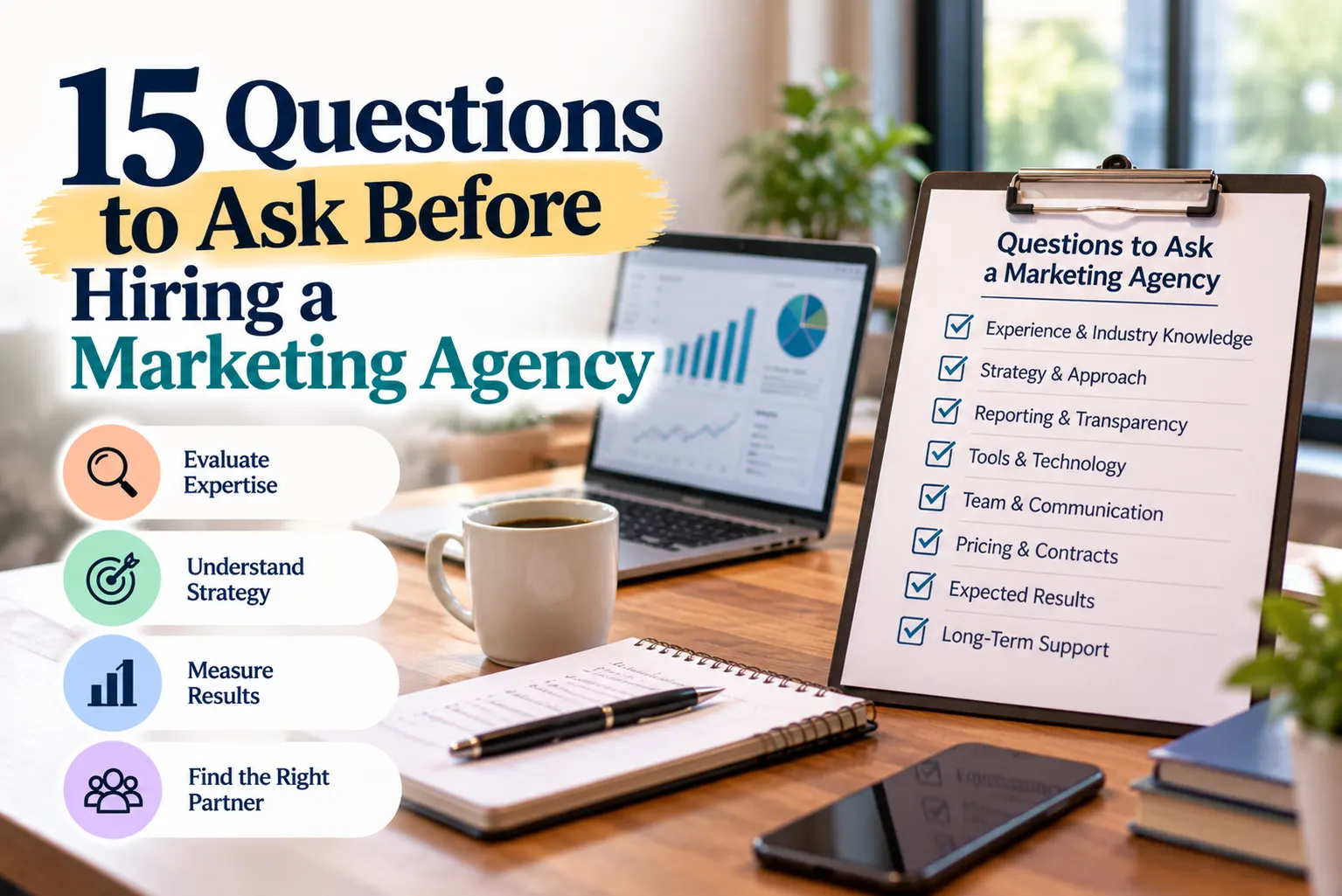
Here are 15 important questions to ask before signing a marketing agency contract.
1. What Experience Do You Have in Our Industry?
Every industry has different customers, competitive pressures, buying cycles, and marketing requirements. An agency that excels at promoting e-commerce products may need a different approach to market professional services, healthcare, or B2B solutions.
Ask whether the agency has worked with businesses similar to yours and what it learned from those engagements.
You should also ask about its experience with your target audience, geographic market, and primary marketing channels.
However, industry experience should not be your only consideration. A capable agency with transferable skills and a strong understanding of your business may still be an excellent fit.
What to look for: Relevant experience, a clear understanding of your market, and the ability to explain how its approach would be adapted to your business.
2. What Marketing Strategy Would You Recommend for Our Business?
A trustworthy marketing agency should understand your business before recommending a strategy.
Ask how it would approach your marketing challenges, identify opportunities, and prioritize activities based on your goals and available resources.
For example, a business struggling with organic visibility may benefit from technical SEO, improved service pages, and content development. A business receiving substantial traffic but few inquiries may need conversion rate optimization rather than simply more visitors.
The agency should explain why its recommendations make sense for your situation.
At Caprus Inc., digital marketing is positioned as part of a broader growth framework, connecting marketing activities with business objectives rather than treating individual channels as isolated services.
What to look for: A customized strategy supported by research, business priorities, and a clear explanation of the expected value of each activity.
3. How Will You Measure Marketing Success?
Marketing success means different things to different businesses.
A company focused on lead generation may prioritize qualified inquiries and customer acquisition costs. An e-commerce business may focus on purchases, revenue, and return on advertising spend. A local business may prioritize calls, appointment requests, and direction requests.
Ask which key performance indicators (KPIs) the agency will track and how those metrics connect to your objectives.
Depending on your strategy, relevant metrics might include:
- Organic traffic and search visibility
- Qualified leads and conversion rates
- Cost per lead and customer acquisition cost
- Sales and revenue attributed to marketing
- Return on advertising spend
- Engagement and audience growth
- Landing-page performance
Be cautious if an agency measures success primarily through impressions, clicks, or rankings without explaining how those metrics support your business.
What to look for: Clearly defined KPIs, appropriate tracking methods, and reporting that connects marketing activity to business outcomes.
4. Can You Share Relevant Case Studies or Previous Results?
Past performance can help you evaluate an agency’s capabilities, although it cannot guarantee future results.
Ask for case studies involving businesses with similar objectives, budgets, or challenges.
A useful case study should explain the initial situation, the strategy implemented, the work completed, the measurement period, and the results achieved.
For example, if an agency claims to have increased organic traffic, ask how traffic changed, what work contributed to the improvement, and whether qualified leads or conversions also increased.
Do not rely exclusively on screenshots or unsupported percentages. Where possible, look for documented evidence and references from previous clients.
What to look for: Specific examples, credible evidence, clear explanations of the agency’s contribution, and realistic claims about what the results mean.
5. Which Marketing Services Are Included in Your Package?
Marketing agencies offer different services, and similar package names do not necessarily mean similar deliverables.
An SEO package might include keyword research, technical audits, on-page optimization, and reporting. Another may focus primarily on content creation and backlink acquisition.
Ask for a detailed breakdown of the services included in your proposed engagement.
Clarify whether the package covers content writing, graphic design, landing-page development, advertising management, analytics setup, technical implementation, and other requirements relevant to your campaign.
You should also identify any services that incur additional charges.
What to look for: A written scope of work, clearly defined deliverables, realistic timelines, and transparency about exclusions and additional costs.
6. Who Will Manage Our Account?
The people presenting your proposal may not be the people managing your campaigns.
Before signing an agreement, ask who will be responsible for your account, which specialists will work on your projects, and who will make strategic decisions.
Find out whether the agency assigns dedicated account managers or distributes work across a shared team.
You should also understand how the agency handles staff changes, project handovers, and urgent requests.
A clear communication structure helps prevent missed deadlines, inconsistent recommendations, and confusion about responsibilities.
What to look for: Defined ownership, relevant expertise, an accessible point of contact, and a reliable process for resolving issues.
7. How Do You Approach SEO and Content Marketing?
If organic visibility is important to your business, understanding the agency’s SEO methodology is essential.
Ask how it conducts keyword research, evaluates competitors, identifies technical issues, develops content, improves internal linking, and measures organic performance.
A comprehensive SEO strategy should consider search intent, website structure, content quality, technical accessibility, and relevant authority-building opportunities.
For content marketing, ask how topics are selected, how content supports the customer journey, and how performance will be evaluated after publication.
Be cautious of agencies promising guaranteed Google rankings, thousands of backlinks, or instant organic growth.
What to look for: A sustainable, research-driven strategy that prioritizes useful content, technical quality, relevant keywords, and measurable business objectives.
8. How Will You Communicate Progress and Report Results?
Regular communication helps you understand what is happening with your marketing investment.
Ask how frequently you will receive reports, whether meetings are included, and how the agency communicates important developments between reporting cycles.
A useful marketing report should explain what was completed, what changed, what the data indicates, which challenges remain, and what the team recommends next.
For example, a decline in organic traffic should not simply appear as a negative number in a spreadsheet. The agency should investigate potential causes and explain any necessary corrective action.
At Caprus Inc., clear reporting, accountability, and performance visibility are part of its stated approach to digital marketing.
What to look for: Consistent updates, understandable reports, access to relevant performance data, and honest communication about both successes and setbacks.
9. What Tools and Technologies Do You Use?
Marketing tools can support research, automation, reporting, and campaign optimization. However, expensive software does not automatically translate into effective marketing.
Ask which tools the agency uses and how they contribute to your campaigns.
Depending on the services provided, these may include Google Analytics 4, Google Search Console, SEO research platforms, advertising dashboards, CRM systems, and conversion-tracking tools.
You should also ask whether the agency needs access to your existing accounts and how access will be managed securely.
Ideally, important business assets and advertising accounts should remain under your ownership, with appropriate permissions granted to the agency.
What to look for: Tools suited to your needs, reliable measurement practices, secure access management, and transparent reporting processes.
10. How Much Do Your Services Cost, and What Is Included?
Marketing agency pricing varies according to scope, expertise, complexity, resources, and engagement model.
Some agencies charge monthly retainers, while others offer project-based pricing, hourly consulting, or a combination of these approaches.
Ask for a complete breakdown of your proposed costs.
Clarify whether the price includes advertising management, content production, software subscriptions, website development, reporting, and third-party expenses.
Remember that advertising spend and agency management fees may be separate.
You should also ask how additional work is approved and billed.
What to look for: Transparent pricing, clearly defined deliverables, documented payment terms, and an understandable process for approving extra expenses.
The cheapest agency is not necessarily the best value. Focus on whether the proposed investment, expertise, and deliverables align with your business priorities.
11. What Results Can We Realistically Expect, and When?
One of the most important questions to ask before hiring a marketing agency concerns expected results.
The answer should reflect your current performance, competition, budget, target audience, and business objectives.
Different marketing channels also operate on different timelines. Paid advertising can generate visibility quickly, although profitable performance is not guaranteed. SEO often requires sustained work before meaningful improvements emerge.
Ask the agency to outline realistic milestones and explain how progress will be evaluated.
For example, early SEO milestones may involve resolving technical problems, improving important service pages, and establishing baseline performance measurements.
These activities can create the conditions for growth, but they do not guarantee a particular ranking or revenue outcome.
What to look for: Evidence-based expectations, realistic timelines, measurable milestones, and no unsupported guarantees.
12. How Will You Adapt the Strategy if Something Is Not Working?
Marketing requires continuous evaluation and adjustment.
An initial strategy may need to change because of competitive activity, audience behavior, campaign costs, algorithm updates, or unexpected performance trends.
Ask what happens when a campaign consistently misses its targets.
Will the agency investigate the underlying causes? Will it recommend changes to targeting, messaging, content, budgets, or landing pages? How will those changes be measured?
The agency should be able to explain its decision-making process without pretending every campaign will perform perfectly.
What to look for: A structured optimization process, evidence-based decisions, early identification of problems, and clear communication about corrective actions.
13. Who Owns the Marketing Assets and Work Produced?
Ownership is an important consideration that businesses sometimes overlook when hiring an agency.
Before signing the contract, clarify who owns the website content, designs, advertising accounts, analytics properties, customer data, landing pages, and other assets created or managed during the engagement.
Review the agreement to understand the rights associated with completed work, licensed materials, third-party tools, and any outstanding payments.
You should also ask what happens to your accounts and assets when the relationship ends.
The exact ownership terms may vary by contract, so make sure the agreement addresses them explicitly.
What to look for: Clear contractual terms, appropriate access to business accounts, protection of confidential information, and a documented handover process.
14. What Are Your Contract Terms and Cancellation Policies?
A marketing partnership should have clear commercial terms.
Ask about the minimum commitment, renewal conditions, notice period, cancellation fees, payment schedule, and circumstances that could result in additional charges.
Find out whether the agency requires a long-term contract or offers an initial project or shorter engagement.
Longer commitments are not automatically a warning sign. Some strategies benefit from continuity. However, you should understand what you are agreeing to before signing.
It is also worth clarifying how disputes, missed deliverables, and significant changes in scope will be handled.
What to look for: Understandable contract language, fair cancellation terms, documented responsibilities, and a reasonable process for resolving disagreements.
15. What Makes Your Agency Different From Other Providers?
The final question helps you understand the agency’s value beyond its service list.
Many agencies offer SEO, paid advertising, social media management, and content marketing. The difference often lies in how these services are planned, coordinated, measured, and connected to business objectives.
Ask what makes the agency’s approach different and why it believes that approach suits your organization.
Look for a clear explanation supported by its methodology, expertise, communication practices, and relevant experience.
For businesses dealing with multiple growth challenges, it may also be useful to evaluate whether the agency understands the relationship between marketing, sales, operations, and technology.
Caprus Inc. positions itself as a growth partner that brings these areas together, combining digital marketing and demand generation with broader business services and growth consulting.
What to look for: A meaningful value proposition, a clear understanding of your business, and an approach that goes beyond completing isolated marketing tasks.
Red Flags to Watch for When Hiring a Marketing Agency
The answers to your questions can reveal potential problems before you commit your budget.
Be cautious if an agency:
- Guarantees specific Google rankings or instant results.
- Cannot explain its strategy in understandable terms.
- Refuses to define deliverables or responsibilities.
- Reports vanity metrics without business context.
- Uses pressure tactics to make you sign immediately.
- Avoids discussing disappointing results or campaign risks.
- Demands unnecessary control over your business accounts.
- Provides vague pricing or unclear cancellation terms.
- Cannot explain how it measures marketing performance.
One warning sign alone does not necessarily mean an agency is unsuitable. However, repeated evasiveness, unrealistic promises, or a lack of accountability deserve careful consideration.
How Caprus Inc. Helps Businesses Approach Growth Strategically
Choosing a marketing agency is not just about finding someone who can publish content, manage advertisements, or improve rankings. It is about finding a partner who understands your business objectives and can translate them into coordinated action.
Caprus Inc. provides digital marketing services that include SEO, search engine marketing, social media marketing, content marketing, email marketing, analytics, and conversion optimization.
Its broader growth consulting services also address business strategy, demand generation, operations, and performance measurement.
This integrated approach is relevant for businesses that want their marketing activities to support broader objectives rather than operate independently.
When evaluating Caprus or any other agency, use the questions in this article to discuss your requirements, understand the proposed strategy, and determine whether the engagement is a suitable fit.
You can explore Caprus’s digital marketing services and growth consulting services to learn more about its approach.
If you are ready to discuss your business challenges, consider requesting a strategy consultation to identify opportunities and potential next steps.
Conclusion
Hiring a marketing agency is an important business decision. The right partner can help you improve visibility, attract qualified prospects, strengthen customer relationships, and build a more structured approach to growth.
However, choosing well requires more than comparing prices or reviewing sales presentations.
The 15 questions to ask before hiring a marketing agency outlined in this guide can help you evaluate expertise, strategy, communication, pricing, reporting, ownership, and long-term suitability.
Look for an agency that asks thoughtful questions about your business, explains its recommendations clearly, measures meaningful outcomes, and communicates honestly when challenges arise.
Most importantly, choose a partner whose approach aligns with your objectives, resources, and expectations.
A strong marketing partnership should provide more than completed tasks. It should give you a clear strategy, reliable execution, measurable progress, and the confidence to make informed business decisions.
FAQs
What questions should I ask before hiring a marketing agency?
Ask about the agency’s experience, strategy, performance metrics, previous results, deliverables, pricing, reporting, communication, contract terms, and ownership of marketing assets. These questions help you evaluate whether the agency is equipped to support your business goals.
How do I choose the right digital marketing agency?
Start by identifying your objectives and budget. Compare agencies based on relevant expertise, strategic approach, transparent pricing, reporting practices, communication, and evidence of previous work. Choose the agency that best matches your needs rather than simply selecting the cheapest option.
How much does it cost to hire a marketing agency?
Marketing agency costs depend on the services required, campaign complexity, industry, expertise, and engagement model. Agencies may charge monthly retainers, project fees, hourly rates, or separate management fees and advertising budgets. Request a detailed proposal before making a decision.
How long does it take to see results from a marketing agency?
Timelines vary by channel, competition, budget, and starting performance. Paid campaigns can generate visibility relatively quickly, while SEO and content marketing often require sustained effort. Ask the agency to establish realistic milestones and explain how progress will be measured.
Should a marketing agency guarantee results?
An agency should be willing to define objectives, explain its methodology, and establish measurable targets. However, guarantees of specific Google rankings or predetermined business outcomes should be treated cautiously because results depend on factors beyond the agency’s control.
What should a marketing agency report include?
A marketing report should include relevant KPIs, completed work, performance changes, insights, challenges, recommendations, and upcoming priorities. Depending on the campaign, it may cover traffic, rankings, qualified leads, conversions, advertising costs, and revenue attribution.
Is it better to hire a full-service marketing agency or individual specialists?
A full-service agency may be suitable when you need coordinated support across multiple channels. Individual specialists can be effective when your requirements are narrow and clearly defined. The right choice depends on your goals, budget, internal capabilities, and need for coordination.
Why should businesses consider Caprus Inc. for digital marketing?
Caprus Inc. offers services including SEO, paid advertising, social media marketing, content marketing, analytics, and conversion optimization. It also provides growth consulting and business services, making it an option for organizations seeking marketing execution connected to broader business objectives.