
For small businesses, generating a consistent flow of qualified leads is often one of the biggest challenges. Whether you run a local service company, consulting firm, healthcare practice, or growing e-commerce business, attracting potential customers requires more than simply having a website.
Organic marketing strategies such as search engine optimization (SEO) and content marketing can build long-term visibility, but they typically require time to develop momentum. When businesses need to reach potential customers sooner, paid advertising offers another way to connect with people actively searching for products or services.
However, running advertisements without a clear strategy can quickly exhaust a limited marketing budget.
A well-planned paid advertising strategy for small businesses focuses on reaching the right audience, selecting appropriate advertising platforms, controlling costs, and converting interested prospects into qualified leads.
At Caprus Inc., we understand that small businesses need marketing investments that support measurable growth. By combining paid advertising, digital marketing strategy, and conversion optimization, businesses can develop campaigns that prioritize meaningful outcomes rather than clicks alone.
This guide explains how small businesses can build effective paid advertising campaigns, avoid common mistakes, and create a more predictable lead generation process.
What Is a Paid Advertising Strategy for Small Businesses?
A paid advertising strategy for small businesses is a structured plan for using advertising platforms to attract potential customers, generate leads, and support business growth within a defined budget.
Unlike organic marketing, paid advertising allows businesses to purchase visibility across search engines, social media platforms, and other digital channels.
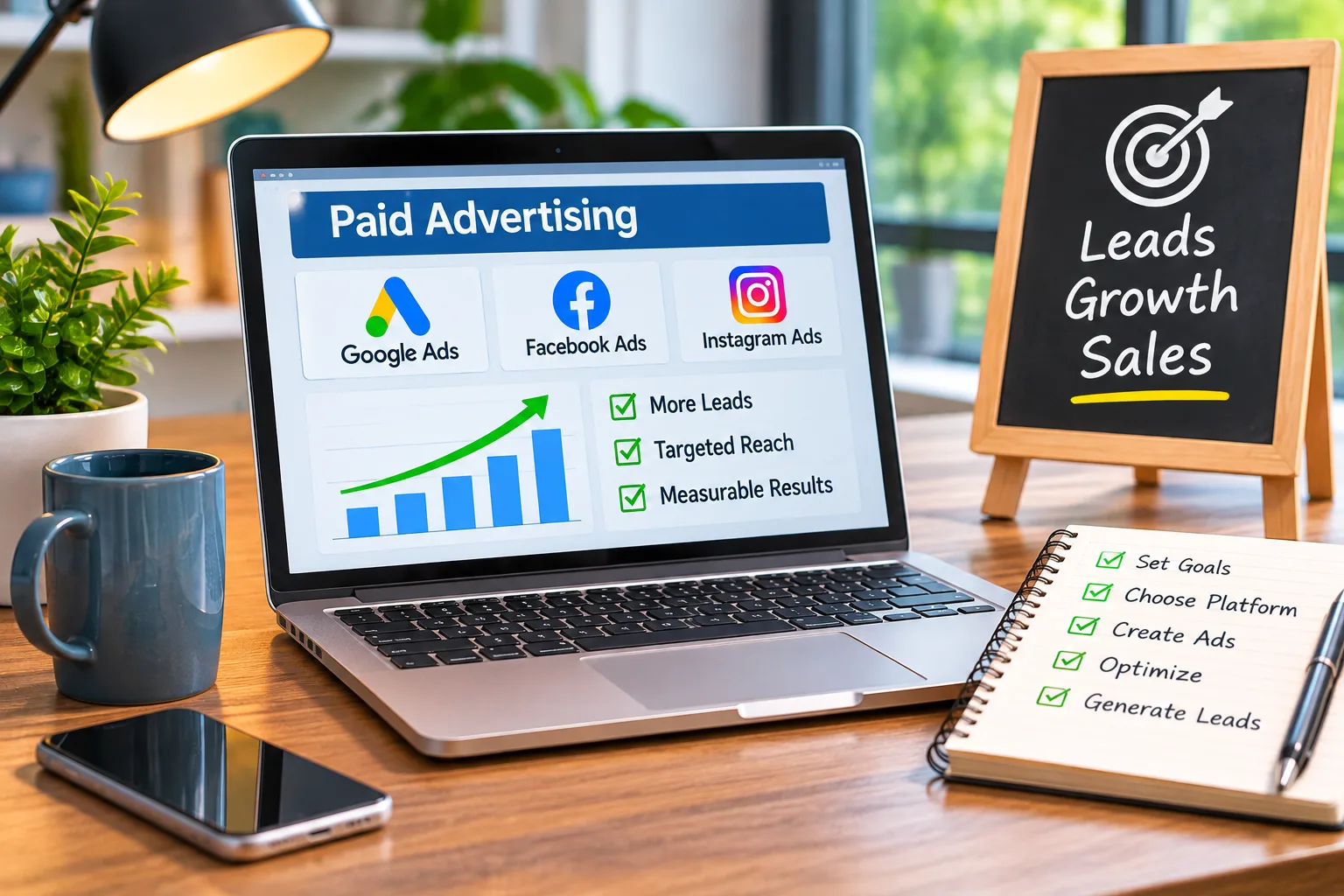
Common paid advertising platforms include:
- Google Ads: Reaches users searching for specific products, services, or solutions.
- Facebook Ads: Helps businesses target audiences based on interests, behaviors, and other available targeting signals.
- Instagram Ads: Supports visual storytelling, brand awareness, and lead generation.
- LinkedIn Ads: Connects B2B businesses with professional audiences.
- Microsoft Advertising: Provides additional search advertising opportunities.
- YouTube Ads: Helps businesses introduce services and engage potential customers through video.
The objective is not simply to increase website traffic. An effective strategy turns advertising investment into measurable opportunities such as phone calls, appointment requests, contact form submissions, and sales inquiries.
Why Small Businesses Should Consider Paid Advertising
Small businesses often compete against established brands with larger marketing budgets and stronger organic visibility.
Paid advertising can help reduce that visibility gap by placing relevant offers in front of potential customers.
1. Reach Potential Customers Faster
SEO and organic content marketing are valuable long-term investments, but they do not guarantee immediate visibility.
Paid search campaigns can begin displaying advertisements after approval and activation, allowing businesses to reach relevant audiences without waiting for organic rankings to improve.
However, generating qualified leads still depends on targeting, competition, budget, and landing-page effectiveness.
2. Target Customers With Specific Needs
Advertising platforms provide targeting options that help businesses focus on relevant audiences.
For example, a plumbing company might target people searching for emergency plumbing services within its service area.
A B2B consulting firm might use LinkedIn to reach decision-makers in specific industries.
This helps businesses avoid spending their entire advertising budget on audiences unlikely to become customers.
3. Control Advertising Spending
Small businesses can establish daily budgets, campaign limits, geographic restrictions, and bidding strategies.
This provides greater control over advertising expenditure.
A business does not necessarily need an enormous budget to begin testing paid advertising. It needs a budget appropriate for its industry, customer acquisition costs, and competitive environment.
4. Measure Campaign Performance
Paid advertising provides measurable information about campaign activity.
Businesses can monitor impressions, clicks, conversions, cost per click, cost per lead, and other performance indicators.
These insights help identify which campaigns deserve additional investment and which require improvement.
How to Build a Paid Advertising Strategy for Small Businesses
Developing an effective advertising campaign requires more than selecting a platform and creating an advertisement.
The following steps provide a practical framework.
Step 1: Define Your Lead Generation Goals
Before launching advertisements, determine what a successful campaign should accomplish.
Different businesses require different conversion actions.
For example:
- A healthcare clinic may prioritize appointment bookings.
- A home services company may want qualified phone calls.
- A consulting agency may target discovery calls.
- An e-commerce business may focus on purchases.
- A local contractor may prioritize quote requests.
Define your primary conversion goal and establish a realistic target cost per lead.
For example, if a business spends $1,000 and generates 25 leads, its average cost per lead is $40.
However, generating inexpensive leads does not automatically make a campaign profitable. Businesses must also evaluate lead quality and the percentage of leads that become paying customers.
Step 2: Choose the Right Advertising Platform
Not every advertising platform is suitable for every business.
The best choice depends on customer intent, industry, budget, and purchasing behavior.
| Advertising Platform | Best Suited For | Primary Advantage |
| Google Search Ads | Local services and high-intent searches | Captures existing demand |
| Facebook Ads | Consumer services and local businesses | Audience discovery and lead generation |
| Instagram Ads | Lifestyle and visually driven businesses | Visual engagement |
| LinkedIn Ads | B2B companies and professional services | Professional audience targeting |
| Microsoft Advertising | Search-based lead generation | Additional search visibility |
| YouTube Ads | Businesses needing demonstrations or education | Video-based engagement |
For businesses needing leads quickly, Google Search Ads are often a practical starting point because they can reach users already searching for relevant services.
Social media advertising may be more suitable when businesses need to introduce their offerings to audiences who are not actively searching.
Step 3: Conduct High-Intent Keyword Research
Keyword selection plays an important role in paid search advertising.
Instead of targeting broad phrases, small businesses should prioritize searches that indicate a potential purchasing decision.
Consider a local roofing company.
Broad keyword:
“Roofing”
Higher-intent keywords:
- Roof repair company near me
- Emergency roof repair services
- Residential roofing contractor
- Roof replacement estimate
- Local roofing installation company
These searches suggest that users may be closer to requesting a service.
Businesses should also use negative keywords to reduce irrelevant traffic.
For example, a company offering professional roofing services might exclude searches related to roofing jobs, training courses, or free DIY instructions.
This helps focus advertising spending on more relevant opportunities.
Step 4: Create Compelling Advertisements
Effective advertisements communicate value quickly.
Potential customers should understand what the business offers, why it is relevant, and what action they should take.
Strong advertisements generally include:
- A clear service or product description
- A relevant customer benefit
- A distinctive value proposition
- A compelling call to action
- Messaging aligned with the landing page
For example:
Headline: Professional Website Design for Small Businesses
Description: Build a professional, conversion-focused website for your growing business. Request a consultation today.
Call to Action: Get a Free Consultation
Avoid exaggerated claims, misleading promises, or guarantees that cannot be supported.
Clear and relevant advertising messaging is more valuable than attention-grabbing language that attracts the wrong audience.
Step 5: Build Landing Pages That Convert
One of the biggest mistakes in small business PPC advertising is directing every advertisement to the homepage.
A homepage typically introduces multiple services, while a paid advertising landing page should focus on one primary objective.
An effective landing page should include:
- A headline matching the advertisement
- A clear explanation of the offer
- Relevant customer benefits
- Trust signals and testimonials, where available
- A prominent contact form or booking option
- Mobile-friendly design
- Fast loading performance
- A clear call to action
For example, an advertisement promoting emergency plumbing services should lead to a page specifically explaining emergency plumbing assistance.
This creates a more consistent experience and reduces unnecessary steps between clicking an advertisement and submitting an inquiry.
At Caprus Inc., digital marketing and website optimization can work together to support campaigns designed around both traffic acquisition and conversion opportunities.
Step 6: Establish a Realistic Paid Advertising Budget
There is no universal advertising budget that works for every small business.
Costs depend on industry competition, location, targeting, and advertising objectives.
A useful starting point is to estimate how many leads the business needs and what it can afford to pay for each one.
For example:
| Metric | Illustrative Value |
| Monthly advertising budget | $1,500 |
| Average cost per click | $3 |
| Estimated clicks | 500 |
| Landing-page conversion rate | 5% |
| Estimated leads | 25 |
| Estimated cost per lead | $60 |
These figures are hypothetical and do not represent guaranteed campaign performance.
Businesses should also account for advertising management costs, creative development, and landing-page improvements when calculating their total marketing investment.
Start with a controlled testing budget and adjust spending based on actual performance.
Step 7: Track Conversions and Optimize Campaigns
Launching a campaign is only the beginning.
Successful paid advertising requires regular monitoring and continuous improvement.
Important performance metrics include:
- Click-Through Rate (CTR): The percentage of impressions that generate clicks.
- Cost Per Click (CPC): The average amount paid for each advertisement click.
- Conversion Rate: The percentage of visitors who complete a desired action.
- Cost Per Lead (CPL): The average advertising cost required to generate one lead.
- Customer Acquisition Cost (CAC): The total acquisition cost divided by the number of customers acquired.
- Return on Ad Spend (ROAS): Revenue attributed to advertising divided by advertising expenditure.
Businesses should also track lead quality, sales conversion rates, and revenue where possible.
Tools such as Google Ads conversion tracking and Google Analytics 4 can help businesses evaluate campaign performance.
For lead generation businesses, connecting advertising data with CRM or sales outcomes can provide a clearer understanding of which campaigns produce valuable customers.
Common Paid Advertising Mistakes Small Businesses Should Avoid
Even well-funded campaigns can underperform when important strategic elements are overlooked.
Targeting Too Broadly
Advertising to everyone often increases irrelevant clicks.
Start with clearly defined audiences, relevant geographic locations, and specific customer needs.
Ignoring Negative Keywords
Without negative keywords, search advertisements may appear for unrelated queries.
Regularly reviewing search terms can help reduce wasted spending.
Sending Traffic to Poor Landing Pages
A compelling advertisement cannot compensate for a confusing website experience.
Landing-page clarity, mobile usability, and strong calls to action are essential.
Focusing Only on Clicks
High traffic does not necessarily mean high-quality leads.
Campaign success should be evaluated using meaningful conversion and customer acquisition metrics.
Changing Campaigns Too Frequently
Constant adjustments can make performance difficult to evaluate and may disrupt automated bidding optimization.
Allow sufficient data to accumulate before making major decisions.
How Long Does Paid Advertising Take to Generate Leads?
Paid advertising campaigns can begin attracting visitors soon after advertisements are approved and activated.
However, there is no guaranteed timeline for generating qualified leads.
Performance depends on several factors, including:
- Search demand
- Advertising competition
- Campaign budget
- Keyword relevance
- Offer attractiveness
- Landing-page quality
- Conversion tracking accuracy
Some businesses may receive inquiries shortly after launch, while others require several weeks of testing and optimization.
The important distinction is that paid advertising can provide faster market exposure, but immediate visibility does not guarantee immediate customers.
Why Combine Paid Advertising With SEO?
Paid advertising and SEO serve different but complementary purposes.
Paid advertising can help businesses reach potential customers while organic visibility is developing.
SEO supports longer-term discoverability through optimized website content, technical improvements, and relevant search visibility.
Combining both strategies can help businesses:
- Capture immediate search demand
- Develop sustainable organic visibility
- Identify high-converting search queries
- Improve landing-page performance
- Reduce dependence on a single acquisition channel
For small businesses, the goal should be to build a balanced marketing system rather than relying entirely on paid advertisements.
How Caprus Inc. Helps Businesses Build Smarter Advertising Strategies
A successful advertising campaign requires strategic planning, audience research, compelling messaging, conversion tracking, and ongoing optimization.
At Caprus Inc., we focus on helping businesses connect digital marketing activities with broader growth objectives.
Our digital marketing services encompass areas such as paid advertising, SEO, content marketing, social media marketing, and performance analytics.
Rather than treating advertising as an isolated activity, businesses benefit when campaigns are aligned with website performance, customer acquisition objectives, and overall marketing strategy.
Whether you are launching your first advertising campaign or looking to improve existing results, a structured approach can help identify opportunities to reduce wasted spending and attract more relevant prospects.
Explore Caprus Inc.’s digital marketing services to learn how a coordinated marketing strategy can support your business growth.
Final Thoughts
A successful paid advertising strategy for small businesses is not about spending the most money. It is about investing strategically to reach potential customers who are most likely to need your products or services.
Choosing the right advertising platform, targeting relevant audiences, developing effective landing pages, and tracking meaningful conversions can make advertising budgets more productive.
For businesses needing leads quickly, paid advertising offers an opportunity to accelerate visibility while building longer-term marketing channels.
However, sustainable success requires continuous testing, realistic expectations, and a clear understanding of customer acquisition costs.
If your business needs a more structured approach to digital marketing and lead generation, Caprus Inc. can help you explore strategies aligned with your business objectives.
Visit Caprus Inc. to learn more about building a measurable digital marketing strategy.
FAQs
What is the best paid advertising strategy for small businesses?
The best paid advertising strategy depends on the business model, target audience, budget, and customer intent. Google Search Ads are often effective for capturing existing demand, while Facebook and Instagram advertising can help businesses reach potential customers through audience targeting.
How much should a small business spend on paid advertising?
There is no fixed minimum budget suitable for every business. Advertising costs vary depending on competition, industry, geographic targeting, and campaign goals. Businesses should establish a testing budget based on their target cost per lead and expected customer value.
Can paid advertising generate leads immediately?
Paid advertising can generate website traffic shortly after campaigns become active, and some businesses may receive inquiries quickly. However, qualified lead generation is not guaranteed and depends on targeting, advertising relevance, budget, and landing-page performance.
Is Google Ads or Facebook Ads better for small business lead generation?
Google Ads is generally useful for reaching customers actively searching for products or services. Facebook Ads can help businesses introduce offers to relevant audiences and generate interest. The best platform depends on customer behavior and campaign objectives.
What is a good cost per lead for small businesses?
A good cost per lead depends on customer lifetime value, sales conversion rate, profit margins, and industry competition. Businesses should evaluate lead quality and customer acquisition costs rather than relying on a universal cost-per-lead benchmark.
Why are my paid advertisements getting clicks but no leads?
Common causes include irrelevant targeting, weak landing pages, unclear offers, slow website performance, complicated contact forms, and poor alignment between advertisements and landing-page content. Conversion tracking should also be checked to ensure leads are being recorded correctly.
Should small businesses invest in SEO or paid advertising first?
Businesses needing faster visibility may benefit from paid advertising, while SEO supports long-term organic discoverability. A combined strategy can help businesses address immediate lead generation needs while developing sustainable search visibility.
How can Caprus Inc. help with paid advertising?
Caprus Inc. offers digital marketing services that include paid advertising, SEO, content marketing, and performance analytics. Businesses can explore its services to develop coordinated marketing strategies focused on relevant traffic, lead generation, and measurable business objectives.