
Businesses today are expected to move faster, serve customers better, control costs, and continuously find new opportunities for growth. At the same time, business owners and internal teams are dealing with increasing administrative workloads, repetitive tasks, customer inquiries, content requirements, data management, and operational responsibilities.
This is where AI and Virtual Assistants can create a powerful combination.
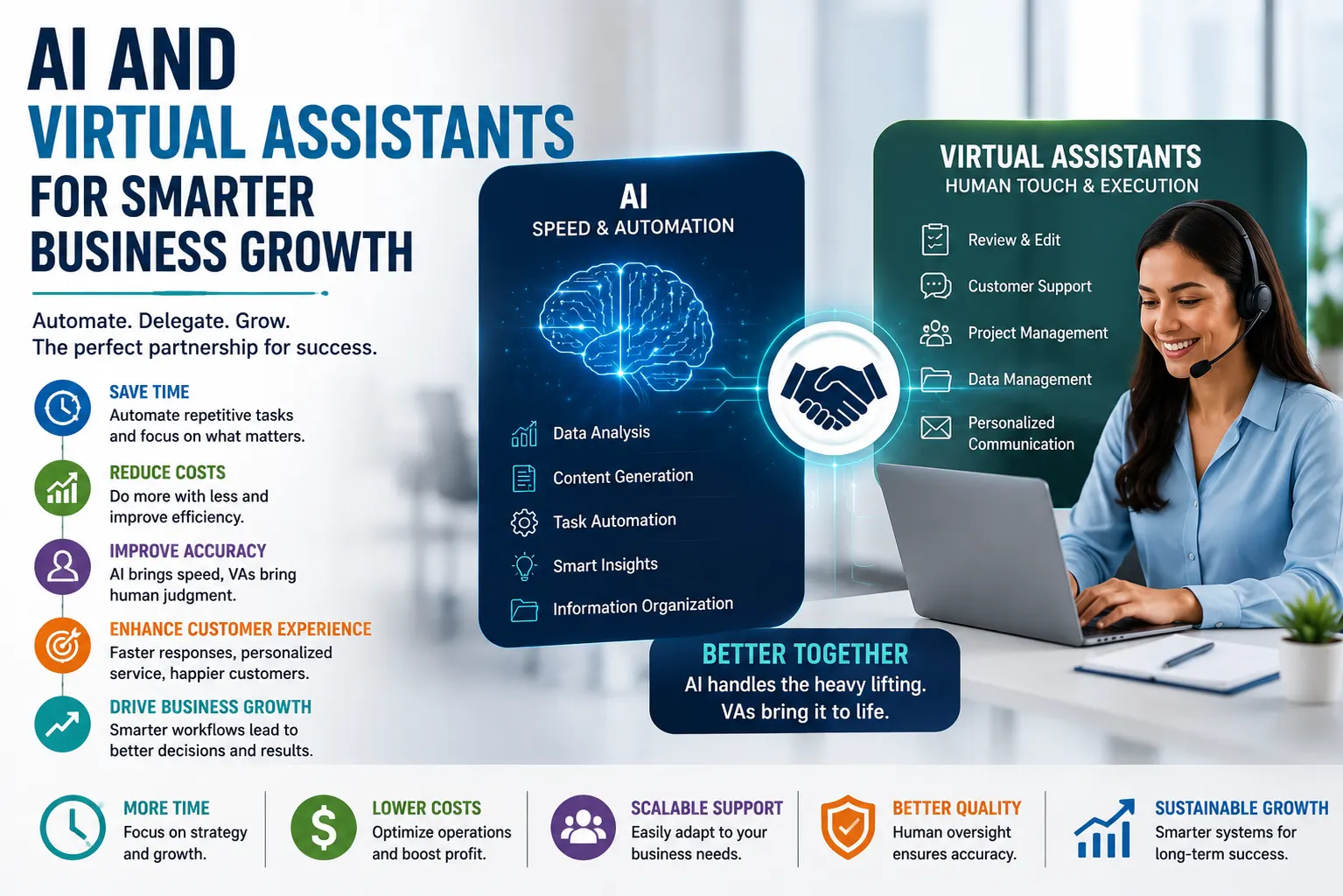
AI can automate repetitive processes, organize information, analyze data, generate drafts, and accelerate routine work. Virtual Assistants (VAs), meanwhile, provide the human judgment, communication, organization, and execution needed to turn those outputs into meaningful business results.
Instead of asking whether businesses should choose AI or Virtual Assistants, a better question is: How can businesses use AI and Virtual Assistants together to achieve more?
The hybrid approach is becoming increasingly relevant as organizations move from experimenting with AI toward integrating it into real business workflows. Recent research and industry analysis increasingly emphasize combining AI automation with human oversight rather than treating AI as a complete replacement for people.
What Are AI and Virtual Assistants?
Before looking at the benefits, it is important to understand the difference between the two.
Artificial Intelligence (AI) refers to technologies that can perform tasks that traditionally require human intelligence. Depending on the tool, AI can help businesses:
- Generate and summarize content
- Analyze large amounts of information
- Draft emails and documents
- Automate repetitive workflows
- Organize and categorize data
- Assist with customer support
- Generate ideas and reports
- Identify patterns and opportunities
A Virtual Assistant, on the other hand, is a remote professional who supports businesses with administrative, operational, marketing, customer service, research, or other specialized tasks.
A VA can manage calendars and emails, coordinate projects, handle customer support, update databases, conduct research, assist with marketing activities, and keep workflows moving.
The important distinction is that AI provides speed and automation, while a skilled Virtual Assistant provides human oversight and execution.
That is what makes the combination so valuable.
Why AI Alone Isn’t Always Enough
AI can dramatically improve productivity, but it does not eliminate the need for human involvement.
AI-generated information may require review. Automated customer responses may need personalization. Business decisions often require context that cannot be captured in a simple prompt. Sensitive communications may require judgment, empathy, and accountability.
Research into AI at work shows a similar pattern: employees are generally more comfortable delegating administrative and documentation tasks to AI, while relationship-driven work and strategic judgment continue to require human involvement.
This creates a natural division of responsibilities.
AI can:
- Process information quickly
- Automate repetitive work
- Produce first drafts
- Summarize meetings
- Organize information
- Support data analysis
Virtual Assistants can:
- Review AI-generated outputs
- Communicate with customers
- Make context-based decisions
- Coordinate people and processes
- Personalize communication
- Monitor workflows
- Take responsibility for execution
The result is not AI replacing people. It is AI helping people accomplish more.
How AI and Virtual Assistants Work Together
The most effective model is usually a workflow where AI handles repetitive or time-consuming parts of a process while a Virtual Assistant manages review, coordination, and execution.
For example, imagine a business receiving dozens of customer inquiries every day.
AI could categorize incoming inquiries, identify frequently asked questions, draft initial responses, and organize customer information.
A Virtual Assistant could then review those responses, personalize them, follow up with prospects, update the CRM, and escalate important issues to the appropriate team member.
Instead of one person manually completing every step, the workflow becomes:
AI → Organize → Draft → Analyze → VA → Review → Personalize → Execute
This approach can increase capacity without requiring the business to immediately build a much larger internal team.
7 Ways AI and Virtual Assistants Can Drive Business Growth
1. Increase Business Productivity
One of the biggest advantages of combining AI with Virtual Assistants is increased productivity.
AI can take care of repetitive activities that consume valuable working hours. A VA can then focus on tasks that require coordination, judgment, communication, and follow-through.
For example, AI can summarize a meeting while a VA converts the summary into action items, assigns responsibilities, updates project management systems, and follows up with team members.
This allows businesses to get more value from the same amount of working time.
2. Reduce Administrative Workload
Administrative tasks can quietly consume a significant portion of a business owner’s or employee’s day.
Email management, calendar scheduling, data entry, document organization, research, reporting, and follow-ups may not directly generate revenue, but they still need to be completed.
AI can accelerate many of these processes, while Virtual Assistants can manage the workflow from beginning to end.
This allows business leaders to spend more time on:
- Business strategy
- Sales
- Client relationships
- Product development
- Partnerships
- Revenue growth
3. Improve Customer Service
Customer expectations are increasingly centered around speed and responsiveness.
AI can help identify customer inquiries, provide suggested responses, summarize customer histories, and support basic automated interactions.
A Virtual Assistant can then take over where human communication matters.
For example, a VA can personally respond to an important customer, resolve a complicated issue, follow up after a sales conversation, or make sure an inquiry does not get lost.
This creates a better balance between automation and human connection.
4. Support Marketing at Scale
Marketing requires consistent execution.
Businesses may need social media posts, blog content, email campaigns, competitor research, lead tracking, reporting, and content updates.
AI can assist with research, brainstorming, first drafts, summaries, content variations, and data analysis. A Virtual Assistant can organize the content calendar, review the outputs, make updates, schedule campaigns, monitor performance, and coordinate with other team members.
For businesses that want to scale their digital presence without creating a large marketing department, this can be particularly useful.
Caprus, for example, positions digital marketing as part of a broader growth framework, with services including SEO, email marketing, social media, content, and demand generation.
5. Improve Operational Efficiency
Growth can create operational problems if processes do not scale with it.
More customers mean more emails. More sales mean more CRM updates. More employees mean more coordination. More marketing activity means more reporting and content management.
AI and Virtual Assistants can help create repeatable workflows around these activities.
AI can handle data processing and automation, while a VA ensures that processes are completed correctly and consistently.
This can help businesses build systems that are less dependent on individual employees remembering every task manually.
6. Make Scaling More Flexible
Hiring a full-time employee for every new responsibility is not always practical, particularly for startups and small businesses. Virtual teams can provide access to specialized support without requiring every function to be built internally.
AI can further increase the productivity of those team members by reducing the amount of manual work they need to perform. This means a business can potentially increase its operational capacity without increasing its overhead at the same rate.
Caprus describes its managed business services and virtual teams as an approach designed to increase operational capacity while reducing unnecessary overhead.
7. Give Business Leaders More Time to Focus on Growth
Perhaps the biggest benefit is not simply completing tasks faster.
It is creating more time for leadership.
When repetitive administrative and operational responsibilities are handled through a combination of AI and Virtual Assistants, business owners can spend more time thinking about the future rather than constantly managing today’s workload. That shift—from working inside the business to working on the business—can become an important part of sustainable growth.
AI vs. Virtual Assistant: Which One Should Your Business Choose?
The answer does not necessarily have to be one or the other.
| Business Need | AI | Virtual Assistant |
| Repetitive data processing | Excellent | Good |
| Content first drafts | Excellent | Excellent |
| Customer communication | Supportive | Excellent |
| Human judgment | Limited | Excellent |
| Scheduling | Excellent | Excellent |
| Data organization | Excellent | Excellent |
| Relationship management | Limited | Excellent |
| Workflow coordination | Supportive | Excellent |
| Strategic decisions | Supportive | Strong human role |
The strongest model combines both.
AI handles what can be automated. Virtual Assistants handle what needs human intelligence, judgment, communication, and ownership.
How to Build an AI + Virtual Assistant Workflow
Businesses considering this approach should avoid automating everything immediately.
Start by identifying repetitive workflows.
Ask:
- Which tasks consume the most employee time?
- Which tasks are repetitive?
- Which tasks can AI safely assist with?
- Where is human review necessary?
- Which processes require direct customer interaction?
- What should be measured after implementation?
Then create a workflow where AI and the VA each have clearly defined responsibilities.
For example:
Lead Generation → AI Research → VA Verification → CRM Update → Personalized Follow-Up → Sales Team
This approach provides structure while maintaining human oversight.
Human review is particularly important as AI becomes more capable. Current enterprise AI thinking increasingly emphasizes governance, accountability, and human oversight when AI systems are integrated into business-critical workflows.
Why Businesses Should Think Beyond “AI vs. Humans”
The biggest mistake businesses can make is treating AI and people as competing resources.
AI is exceptionally useful for speed, repetition, information processing, and automation.
People are exceptionally valuable for judgment, relationships, creativity, empathy, accountability, and decision-making. When the two are combined strategically, businesses can create a more efficient operating model.
That is why the future of business operations is likely to be less about AI versus employees and more about AI-augmented teams.
How Caprus Can Help Your Business
Caprus Inc. helps organizations combine people, processes, technology, and growth strategy to create more scalable operations.
Rather than focusing only on individual tasks, Caprus takes an outcome-focused approach that integrates growth consulting, digital marketing, managed business services, virtual teams, and technology solutions.
Its Virtual Assistance services can support areas such as calendar management, email management, customer support, data entry, and graphic design, while its technology capabilities include AI solutions.
For businesses exploring how to integrate AI with human support, the objective should not simply be to add another AI tool.
The goal should be to identify where automation can improve efficiency, where human expertise is essential, and how the entire workflow can contribute to measurable business growth.
You can learn more about Caprus through its Business Services & Growth Consulting services and explore how a combination of virtual assistance, technology, digital marketing, and growth consulting can support your organization.
Final Thoughts
AI and Virtual Assistants are not competing solutions—they are complementary business growth tools. AI can make work faster. Virtual Assistants can make it more human, organized, accurate, and actionable.
Together, they can help businesses reduce repetitive work, improve customer service, increase productivity, support marketing, strengthen operations, and create additional capacity for growth.
The businesses that benefit most from AI will not necessarily be those that automate the most. They will be the businesses that understand what to automate, what to delegate, and where human expertise should remain in control.
If your business is dealing with operational overload, inconsistent execution, or limited internal capacity, combining AI with a skilled Virtual Assistant could be the next step toward building a more efficient and scalable business.
FAQs
Can AI replace Virtual Assistants?
AI can automate many repetitive tasks, but it does not completely replace the need for skilled Virtual Assistants. Human judgment, customer relationships, communication, quality control, and workflow ownership remain important in many business processes.
How can AI and Virtual Assistants help small businesses?
AI and Virtual Assistants can help small businesses reduce administrative workload, improve customer response times, manage marketing activities, organize data, support sales processes, and increase operational capacity without immediately requiring a large in-house team.
What tasks can AI and Virtual Assistants handle together?
Common examples include email management, customer support, lead research, CRM updates, content creation, social media management, scheduling, data entry, reporting, research, and administrative workflows.
Is an AI Virtual Assistant the same as a human Virtual Assistant?
No. An AI assistant is software that performs or assists with tasks using artificial intelligence. A human Virtual Assistant is a professional who can use AI tools while also applying judgment, communication skills, creativity, and business context.
How do I know which tasks to automate with AI?
Start with repetitive, time-consuming, and relatively predictable tasks. Processes involving sensitive information, complex customer relationships, strategic decisions, or significant business consequences should generally include appropriate human review.
Can Caprus provide Virtual Assistant and AI-related business support?
Yes. Caprus provides Virtual Assistance and Technology services, including support for administrative operations and AI solutions. It also combines these capabilities with digital marketing and growth consulting to support broader business objectives.
Why should businesses combine AI with Virtual Assistants?
The combination allows AI to handle speed-intensive and repetitive work while Virtual Assistants provide human oversight, communication, personalization, and execution. This can create a more productive and scalable operating model than relying exclusively on either approach.