
Digital marketing has created enormous opportunities for small businesses. A company no longer needs a massive advertising budget to reach potential customers, build brand awareness, or compete with established brands. With the right strategy, even a small business can attract relevant audiences, generate qualified leads, and build a recognizable online presence.
However, having access to digital marketing tools does not automatically translate into business growth.
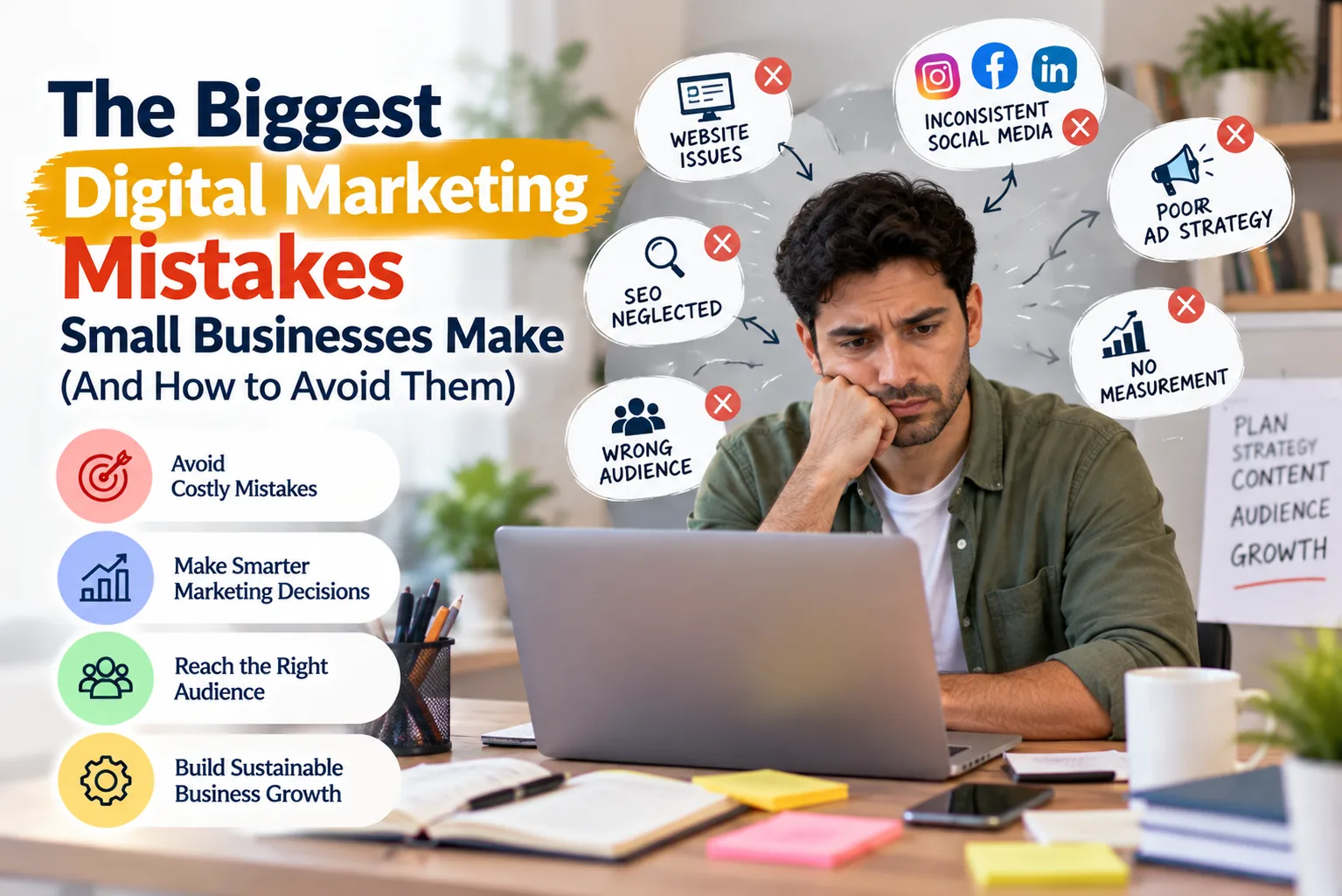
Many small businesses invest in social media, search engine optimization (SEO), paid advertising, and website development without establishing a clear strategy. They publish content inconsistently, target the wrong audiences, overlook website performance, or measure success using metrics that have little connection to revenue.
These mistakes can waste valuable resources and make digital marketing appear less effective than it actually is.
Understanding the biggest digital marketing mistakes small businesses make is the first step toward building a more effective marketing strategy. By identifying these problems early, businesses can allocate their budgets more intelligently, improve customer acquisition, and create sustainable growth.
Let’s explore the most common digital marketing mistakes and how to avoid them.
Marketing Without a Clear Strategy
One of the biggest digital marketing mistakes small businesses make is starting campaigns without a defined strategy.
A business might create social media accounts, publish blogs, run advertisements, and redesign its website simply because competitors are doing the same things.
The problem is that marketing activities without clear objectives often produce disconnected results.
Before investing in digital marketing, businesses should identify what they want to achieve. Their goals might include increasing website traffic, generating qualified leads, improving online sales, expanding into new markets, or increasing customer retention.
Once the objectives are established, every marketing activity should support them.
How to avoid this mistake:
- Define specific, measurable marketing objectives.
- Identify your ideal customer and their purchasing behavior.
- Research competitors and market opportunities.
- Choose marketing channels based on audience intent.
- Establish a realistic budget and timeline.
- Review performance regularly and adjust your strategy.
For example, a local service business that needs more appointment bookings may benefit more from local SEO, Google Business Profile optimization, and conversion-focused landing pages than from investing heavily in broad brand-awareness campaigns.
The right strategy depends on the business, its audience, its budget, and its goals.
Ignoring Search Engine Optimization
Paid advertising can generate visibility quickly, but businesses that neglect SEO may miss opportunities to attract customers through organic search.
Search engine optimization helps businesses improve their visibility when potential customers search for relevant products, services, or information.
Unfortunately, many small businesses treat SEO as a one-time activity. They optimize a few page titles, publish occasional blog posts, and expect rankings to improve without ongoing effort.
Effective SEO requires a more comprehensive approach.
Important elements include technical SEO, keyword research, search intent analysis, content optimization, internal linking, website performance, and authority development.
Local businesses must also consider local search optimization and the accuracy of their business information across relevant platforms.
How to avoid this mistake:
- Research keywords that match your products, services, and customer needs.
- Optimize page titles, meta descriptions, headings, and URLs.
- Improve website navigation and internal linking.
- Identify technical problems affecting crawling and indexing.
- Create useful content that answers customer questions.
- Optimize your Google Business Profile if you serve local customers.
- Monitor organic performance using Google Search Console and Google Analytics 4.
SEO should not be treated as a guaranteed shortcut to first-page rankings. Results depend on competition, website quality, search intent, and other factors.
However, a consistent SEO strategy can help businesses build long-term search visibility and attract people who are already looking for relevant solutions.
Targeting the Wrong Audience
Even a well-designed marketing campaign can fail when it reaches the wrong people.
Some businesses define their target audience too broadly, assuming that anyone who could potentially use their products or services is a suitable customer.
This approach can increase advertising costs, reduce engagement, and generate unqualified leads.
A business selling premium professional services, for example, may struggle if its advertising primarily reaches people looking for the cheapest available option.
The solution is to understand the audience before choosing marketing channels or creating campaigns.
How to avoid this mistake:
- Define your ideal customer profile.
- Understand customer problems, priorities, and buying motivations.
- Identify the locations and demographics relevant to your business.
- Study the search terms customers use when looking for solutions.
- Segment audiences according to their needs and purchasing stage.
- Use campaign data to identify which audiences generate qualified leads.
Customer research does not need to be complicated. Reviewing sales conversations, customer feedback, website analytics, and frequently asked questions can reveal valuable insights.
The more accurately you understand your audience, the easier it becomes to create relevant content and allocate marketing resources effectively.
Treating Social Media as the Entire Marketing Strategy
Social media is a valuable marketing channel, but it should not automatically become the center of every small business’s marketing strategy.
Some businesses focus almost entirely on publishing posts, increasing followers, and receiving likes.
Although these activities can support brand awareness, they do not necessarily translate into qualified leads or sales.
A business may have an active Instagram account but a poorly optimized website, weak search visibility, and no clear conversion process.
This creates a disconnect between attracting attention and generating revenue.
How to avoid this mistake:
- Select platforms based on where your target customers spend time.
- Create content that educates, informs, and addresses customer concerns.
- Include relevant calls to action.
- Direct interested users toward useful website pages or lead-generation resources.
- Track website visits, inquiries, bookings, and sales generated by social media.
- Repurpose successful content across appropriate channels.
Consistency matters, but publishing more content is not always the answer.
A focused social media strategy that supports broader business objectives is often more useful than maintaining several accounts without a clear purpose.
Having a Website That Looks Good but Doesn’t Convert
A visually attractive website can still perform poorly if visitors cannot quickly understand what the business offers or how to take the next step.
Common website conversion problems include confusing navigation, slow-loading pages, unclear messaging, intrusive pop-ups, weak calls to action, and complicated contact forms.
Visitors may leave without contacting the business, even when its products or services are relevant to their needs.
This is why website design should focus on usability and conversions, not aesthetics alone.
How to avoid this mistake:
- Communicate your main value proposition clearly.
- Make important services and products easy to find.
- Ensure the website works properly on mobile devices.
- Use clear calls to action, such as “Request a Consultation” or “Get a Quote.”
- Reduce unnecessary steps in forms and checkout processes.
- Display credible testimonials, reviews, and relevant trust signals.
- Monitor landing-page performance and conversion rates.
- Test improvements using actual visitor behavior and performance data.
Businesses should also review whether their landing pages match the promises made in their advertisements and search results.
If an advertisement promotes a specific service, sending visitors to a generic homepage may introduce unnecessary friction.
A focused landing page can provide a more relevant experience and make the next step clearer.
Publishing Content Without a Content Strategy
Content marketing can help businesses answer customer questions, demonstrate expertise, improve search visibility, and support purchasing decisions.
However, publishing content simply to maintain a posting schedule can produce disappointing results.
Some businesses publish generic blogs that do not address customer problems. Others target keywords without considering search intent or create several articles covering nearly identical topics.
The result is a website with plenty of content but limited strategic value.
How to avoid this mistake:
Develop a content strategy around your customers’ questions and decision-making process.
For example, a company offering digital marketing services might create content covering:
- Common marketing problems and their solutions.
- Comparisons between relevant marketing approaches.
- Practical guides for improving website performance.
- Industry-specific marketing challenges.
- Questions customers should ask before hiring an agency.
- Case studies supported by verifiable results.
Organize content into relevant topic clusters and connect related articles using internal links.
Every article should have a clear purpose, whether that is attracting informational traffic, building topical authority, supporting a service page, or helping potential customers evaluate their options.
Content quality also matters more than publishing volume alone. Useful, accurate, original content is more valuable than repetitive articles created solely to target keywords.
Spending on Paid Advertising Without Tracking Conversions
Paid advertising can help businesses reach relevant audiences, test offers, and generate leads. However, poorly managed campaigns can consume budgets without producing meaningful business outcomes.
A common mistake is optimizing campaigns around clicks or impressions without checking whether those interactions lead to qualified inquiries or purchases.
High traffic does not automatically mean high revenue.
For example, an advertisement may attract hundreds of visitors but generate few leads because the targeting is too broad, the offer is unclear, or the landing page does not meet visitors’ expectations.
How to avoid this mistake:
- Define the primary conversion before launching a campaign.
- Install and test appropriate conversion tracking.
- Use relevant audience targeting and keyword selection.
- Review search terms and exclude irrelevant traffic where appropriate.
- Match advertisements to their landing pages.
- Monitor cost per lead, lead quality, conversion rate, and customer acquisition cost.
- Evaluate campaign profitability rather than clicks alone.
Businesses should also distinguish between leads and qualified leads. Ten inquiries from people who are unlikely to purchase may be less valuable than three inquiries from suitable prospects.
Before increasing an advertising budget, confirm that tracking is reliable and the campaign is generating results that matter to the business.
Measuring Vanity Metrics Instead of Business Results
Digital marketing platforms provide numerous metrics, but not all metrics have equal business value.
Followers, impressions, page views, and likes can indicate visibility or engagement. However, these numbers do not independently demonstrate whether marketing is generating revenue.
The problem occurs when businesses celebrate improvements in surface-level metrics while ignoring leads, conversions, sales, and customer retention.
How to avoid this mistake:
Connect marketing performance to specific business objectives.
| Business Objective | Useful Metrics |
| Increase organic visibility | Organic clicks, impressions, relevant keyword performance |
| Generate qualified leads | Qualified inquiries, conversion rate, cost per qualified lead |
| Increase online sales | Transactions, revenue, average order value |
| Improve advertising efficiency | Cost per acquisition, return on ad spend |
| Improve website performance | Conversion rate, engagement, form completion rate |
| Strengthen customer retention | Repeat purchases, retention rate, customer lifetime value |
The right metrics depend on the business model and campaign objective.
Use Google Search Console to understand search performance and Google Analytics 4 to evaluate website activity and configured conversions.
Advertising platforms and customer relationship management systems can provide additional information about lead quality, acquisition costs, and sales outcomes.
The goal is to make decisions based on meaningful evidence rather than selecting whichever metrics look most impressive.
Ignoring Customer Reviews and Online Reputation
Potential customers frequently research a business before contacting it or making a purchase.
Reviews, testimonials, business information, and responses to customer feedback can influence how people perceive a company.
Unfortunately, some businesses neglect their online reputation until they receive negative feedback or notice a decline in inquiries.
For local businesses, this can mean missing opportunities to build trust and improve their customer experience.
How to avoid this mistake:
- Keep your Google Business Profile accurate and updated.
- Encourage genuine customers to leave honest reviews.
- Respond professionally to positive and negative feedback.
- Address recurring customer complaints.
- Keep contact details, business hours, and service information consistent.
- Use authentic testimonials where appropriate and with permission.
Reviews should reflect genuine customer experiences. Businesses should never purchase fake reviews or offer incentives in exchange for positive ratings in violation of platform policies.
Online reputation management is not simply about collecting five-star reviews. It is also about listening to customers and improving the experience that generates those reviews.
Expecting Immediate Results From Every Marketing Channel
Another major mistake is expecting every digital marketing activity to produce immediate results.
Different channels operate on different timelines.
Paid advertising may generate traffic shortly after launch, provided the campaign is configured correctly and has sufficient budget. SEO typically requires ongoing work and can take time to demonstrate meaningful improvements. Content marketing may build value gradually as useful resources accumulate.
Businesses that abandon a strategy too early may never give it a reasonable opportunity to work.
At the same time, continuing to invest in a consistently underperforming campaign without investigating the cause is equally problematic.
How to avoid this mistake:
- Establish realistic expectations before launching campaigns.
- Define appropriate evaluation periods.
- Monitor leading indicators as well as final outcomes.
- Investigate performance changes before making major decisions.
- Test improvements systematically.
- Reallocate resources when evidence supports a change.
Marketing requires patience, but patience should not replace accountability.
A strong strategy combines realistic timelines with regular performance reviews and a willingness to improve what is not working.
Trying to Do Everything Without the Right Expertise
Small businesses often operate with limited budgets and small teams. It is understandable that owners try to manage SEO, content, advertising, social media, website updates, and analytics themselves.
However, managing every channel without sufficient time or expertise can lead to inconsistent execution and missed opportunities.
The problem is not that business owners should never manage marketing internally. It is that they need to recognize their capacity and prioritize activities accordingly.
How to avoid this mistake:
Start by identifying the marketing activities most likely to contribute to your business objectives.
You can manage some tasks internally while outsourcing specialized work when necessary.
For example, a business might handle routine social media updates internally while working with an experienced team on technical SEO, paid advertising, conversion optimization, or marketing analytics.
A structured approach can help businesses access relevant expertise without unnecessarily expanding their internal teams.
How Caprus Inc. Can Help Small Businesses Avoid These Mistakes
Avoiding digital marketing mistakes requires more than following isolated tips. Businesses need a coordinated approach that connects strategy, execution, measurement, and continuous improvement.
Caprus Inc. provides digital marketing and business growth services designed to help organizations strengthen their marketing efforts and improve operational efficiency.
Its service areas include SEO, content marketing, social media marketing, paid advertising, e-commerce marketing, and broader business support.
Depending on a business’s objectives, an effective marketing engagement may involve:
- Identifying the most relevant audience and growth opportunities.
- Developing a focused digital marketing strategy.
- Improving organic search visibility.
- Creating useful, search-focused content.
- Optimizing campaigns and website conversion paths.
- Establishing appropriate performance metrics.
- Monitoring results and identifying opportunities for improvement.
The starting point should always be understanding the business’s current position, available resources, target customers, and objectives.
Rather than investing in every marketing channel simultaneously, businesses can prioritize the activities most relevant to their growth goals.
Explore Caprus Inc.’s digital marketing services to learn how a structured marketing approach can support your business objectives.
Final Thoughts
The biggest digital marketing mistakes small businesses make are often not caused by a lack of tools or opportunities. They happen when businesses invest in activities without a clear strategy, misunderstand their audience, overlook conversion problems, or fail to measure meaningful results.
The solution is not necessarily to spend more money or publish more content.
It is to make better decisions.
Start by defining your goals, understanding your customers, improving your website, and selecting the right marketing channels. Establish meaningful performance metrics and review them regularly. When results fall short of expectations, investigate the reasons and adjust your approach.
Most importantly, remember that digital marketing should support business growth—not simply generate online activity.
With a focused strategy, consistent execution, and data-informed decision-making, small businesses can reduce wasted effort, improve lead quality, and build a stronger online presence over time.
Looking to improve your digital marketing strategy? Visit Caprus Inc. to explore digital marketing and business growth services that can help your organization identify opportunities and move toward its objectives.
FAQs
What are the biggest digital marketing mistakes small businesses make?
The biggest digital marketing mistakes include operating without a clear strategy, ignoring SEO, targeting the wrong audience, relying exclusively on social media, neglecting website conversions, publishing content without a plan, failing to track advertising conversions, and measuring vanity metrics instead of business outcomes.
Why do digital marketing strategies fail for small businesses?
Digital marketing strategies can fail when objectives are unclear, audience targeting is inaccurate, budgets are poorly allocated, conversion tracking is unreliable, or marketing activities are disconnected from business goals. Inconsistent execution and unrealistic expectations can also contribute to disappointing results.
How can small businesses improve their digital marketing?
Small businesses can improve digital marketing by defining measurable goals, researching their audience, investing in relevant SEO and content, improving website usability, tracking conversions, and reviewing campaign performance regularly. Prioritizing activities according to business objectives helps make limited resources more effective.
What is the most common SEO mistake small businesses make?
A common SEO mistake is treating optimization as a one-time task. Effective SEO requires ongoing attention to technical performance, search intent, content quality, internal linking, keyword relevance, and user experience. Businesses should also monitor indexing and organic search performance.
How much should a small business spend on digital marketing?
There is no universal digital marketing budget that works for every small business. The appropriate investment depends on the business model, industry competition, growth objectives, available resources, and customer acquisition costs. Businesses should establish a realistic budget and measure performance before increasing spending.
Why is website conversion optimization important?
Website conversion optimization helps businesses turn more relevant visitors into leads, inquiries, bookings, or customers. Improvements to messaging, navigation, page speed, mobile usability, calls to action, and forms can reduce friction and make it easier for visitors to take the next step.
Which digital marketing channels are best for small businesses?
The best channels depend on the target audience and business objectives. SEO and local search can help attract people actively seeking relevant services. Paid advertising can provide targeted reach, while social media and content marketing can support brand awareness, education, and customer engagement. Businesses should prioritize channels based on their specific needs.
How can a small business measure digital marketing success?
Businesses should track metrics connected to their objectives, including qualified leads, conversion rates, customer acquisition costs, revenue, and return on advertising spend where appropriate. Google Search Console and Google Analytics 4 can help evaluate organic search performance and website activity when tracking is configured correctly.
Should small businesses hire a digital marketing agency?
Hiring a digital marketing agency can be useful when a business needs specialized expertise, consistent execution, or more capacity than its internal team can provide. Before hiring, businesses should evaluate the agency’s processes, services, reporting practices, communication, and ability to connect marketing activities to business objectives.
How can Caprus Inc. help small businesses improve digital marketing?
Caprus Inc. offers digital marketing and business growth services, including SEO, content marketing, social media marketing, paid advertising, and e-commerce marketing. Businesses can explore its services to determine which areas align with their marketing challenges and growth objectives.