
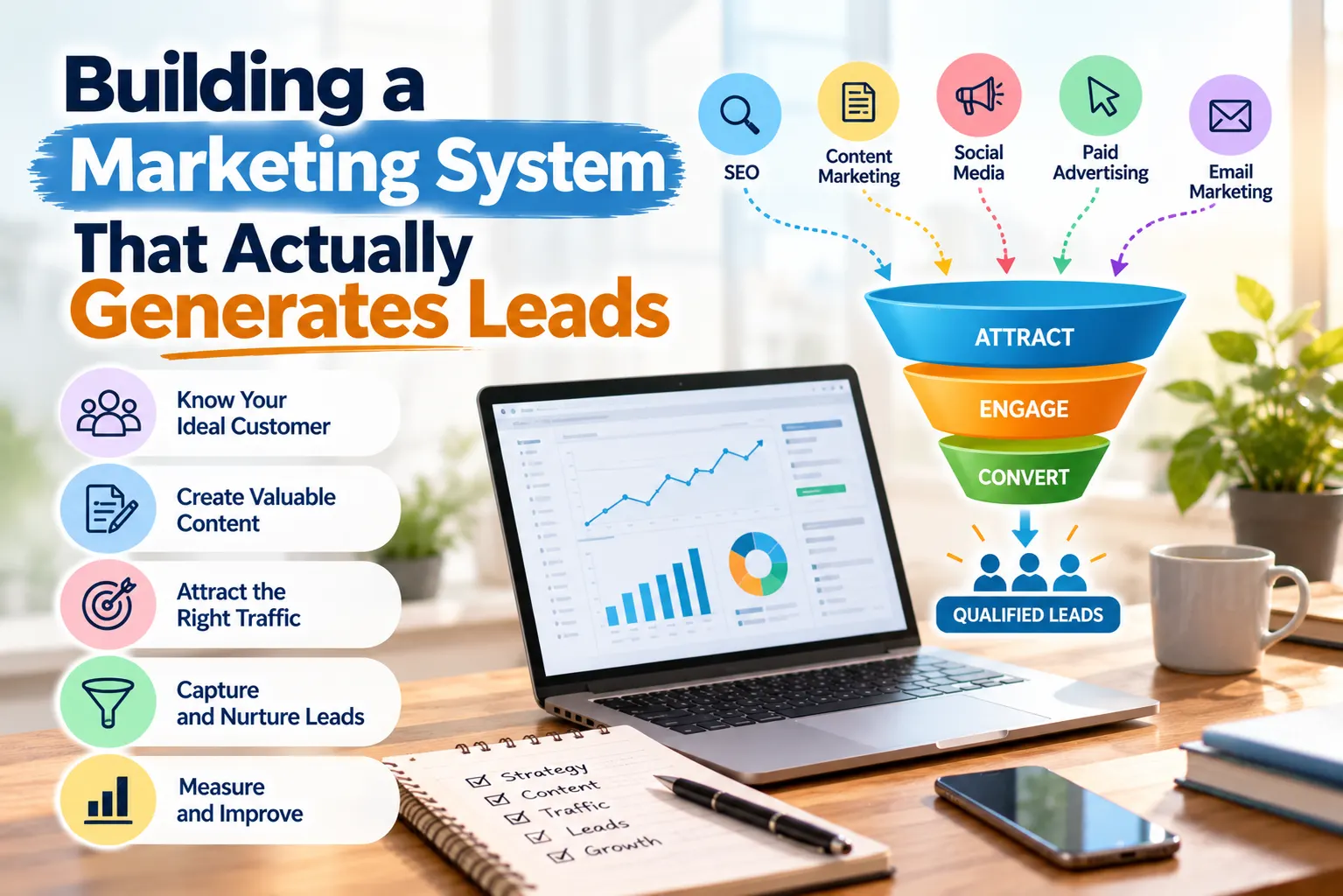
Many businesses invest in digital marketing but struggle to generate consistent leads. They publish social media posts, run paid advertising campaigns, update their websites, and occasionally publish blogs. Yet, despite all these activities, their sales pipelines remain unpredictable.
The problem is not always the marketing channels themselves. Often, the real issue is that these activities operate independently without a unified strategy to attract prospects, convert visitors, nurture potential customers, and generate sales opportunities.
Building a marketing system that actually generates leads requires more than running campaigns. It requires a structured process that connects marketing activities to measurable business outcomes.
A successful marketing system brings together audience research, search engine optimization (SEO), content marketing, paid advertising, conversion optimization, lead nurturing, and performance tracking. Each component serves a specific purpose, and every activity contributes to a larger customer acquisition strategy.
For businesses looking to grow sustainably, the objective is not simply to generate more website traffic or social media engagement. It is to create a repeatable process that attracts the right audience and turns relevant prospects into qualified leads.
In this guide, we will explore how to build a lead generation marketing system that supports long-term business growth.
What Is a Marketing System for Lead Generation?
A marketing system for lead generation is a structured framework that attracts potential customers, captures their information, nurtures their interest, and moves qualified prospects toward a purchase or sales conversation.
Instead of treating marketing activities as isolated tasks, a marketing system connects them into a coordinated process.
For example, a business might publish an SEO-optimized blog targeting a problem its customers frequently experience. Visitors discover the article through Google, explore a relevant service page, and complete a contact form to request a consultation. The sales team then follows up, qualifies the inquiry, and works toward converting the prospect into a customer.
Each step supports the next.
A well-designed marketing system typically includes six essential components:
- Audience research: Understanding the people most likely to purchase your services.
- Traffic generation: Attracting relevant visitors through SEO, content, social media, and paid advertising.
- Lead capture: Encouraging visitors to submit inquiries or share their contact information.
- Lead nurturing: Building trust through relevant information and follow-up communication.
- Sales alignment: Ensuring qualified leads reach the appropriate person at the right time.
- Performance measurement: Identifying which activities generate meaningful business results.
When these components work together, businesses can make more informed marketing decisions and improve the consistency of their lead generation efforts.
1. Start With Your Ideal Customer, Not Your Marketing Channels
One of the most common mistakes businesses make is choosing marketing channels before understanding their target audience.
They launch campaigns on multiple platforms because competitors use them. They publish generic content because it attracts attention. They invest in advertising without determining whether the audience is likely to become a customer.
A better approach starts with customer research.
Before building your marketing system, identify:
- Who are your ideal customers?
- What problems are they trying to solve?
- What services or products are they actively searching for?
- What objections prevent them from making a purchase?
- What factors influence their buying decisions?
- Which channels do they use when researching solutions?
- What makes your business different from competitors?
For B2B businesses, additional considerations include company size, industry, decision-making authority, purchasing timelines, and budget requirements.
For example, a company selling digital marketing services to small businesses may need to target owners struggling with low organic traffic, inconsistent inquiries, or poor website conversions.
Understanding these problems helps the company create relevant content, targeted campaigns, and compelling offers.
The more accurately your marketing reflects your customers’ needs, the easier it becomes to attract qualified prospects rather than irrelevant traffic.
2. Build a Website That Converts Visitors Into Leads
Your website should do more than describe your business. It should guide visitors toward a meaningful next step.
Even a successful SEO or paid advertising campaign can produce disappointing results if the landing page fails to communicate value or make contacting your business easy.
A lead-generating website should include several essential elements.
Clear Value Proposition
Visitors should quickly understand what your business offers, whom it helps, and why they should consider your services. Avoid vague headlines that could describe almost any company. Instead, communicate the specific problem you solve and the value customers can expect.
Dedicated Service Pages
Each major service should have a dedicated page explaining the offering, its benefits, the problems it addresses, and how prospective customers can get started. These pages also provide opportunities to target relevant commercial keywords.
Strong Calls to Action
Use clear calls to action (CTAs), such as:
- Request a Consultation
- Get a Free Quote
- Book a Discovery Call
- Discuss Your Project
Choose CTAs that match your audience’s readiness to purchase.
Trust-Building Elements
Testimonials, case studies, client feedback, relevant credentials, and transparent service information can help visitors evaluate your business.
Only publish genuine testimonials and verifiable results.
Simple Contact Forms
Ask for the information your team needs to respond appropriately, without introducing unnecessary friction. For many businesses, a name, business email, company name, and brief description of the requirement may be sufficient for an initial inquiry.
Finally, test the website on mobile devices, check loading performance, and ensure forms function correctly. A website becomes a stronger lead generation asset when its content, design, and conversion pathways work together.
3. Use SEO and Content Marketing to Attract High-Intent Prospects
Search engine optimization is an important component of a sustainable customer acquisition strategy because it helps businesses appear when potential customers search for relevant information, products, and services.
However, generating organic traffic should not be the only objective.
Your content strategy should attract visitors who are likely to benefit from your offerings and guide them toward the next stage of the buying journey.
Create Content for Different Stages of the Funnel
A practical content strategy addresses three stages of customer awareness.
Top of the funnel: Awareness
These prospects are researching problems and possible solutions.
Content ideas include:
- Why Is My Website Not Generating Leads?
- Common Digital Marketing Mistakes Small Businesses Make
- How to Improve Organic Website Traffic
Middle of the funnel: Consideration
These prospects understand their problem and are evaluating possible approaches.
Content ideas include:
- SEO vs. Paid Advertising: Which Is Better for Lead Generation?
- How to Choose a Digital Marketing Agency
- What Should a Lead Generation Strategy Include?
Bottom of the funnel: Decision
These prospects are closer to purchasing.
Content ideas include:
- Digital Marketing Services for Growing Businesses
- What to Expect From a Marketing Agency
- How to Evaluate a Digital Marketing Proposal
Link relevant informational articles to service pages, case studies, and consultation opportunities.
For example, an article explaining how to improve website conversions could link to your conversion optimization services. This approach creates a logical pathway from discovering a problem to exploring a solution.
Optimize Content for Search Intent
Keyword research should consider what users actually want to accomplish.
Someone searching for “what is lead generation” probably needs an explanation. Someone searching for “lead generation agency for B2B companies” may be evaluating service providers.
Matching content to search intent improves relevance and helps visitors find the information they need. For Caprus Inc., this means connecting educational content with relevant business services rather than relying on blog traffic alone.
Explore the services available through Caprus Inc. to understand how digital marketing and business support can contribute to a broader growth strategy.
4. Combine Marketing Channels Instead of Using Them in Isolation
Businesses often ask which marketing channel generates the most leads.
There is no universal answer. Results depend on the target audience, industry, budget, competition, offer, and sales cycle.
Instead of expecting one channel to perform every function, build a coordinated channel mix.
| Marketing Channel | Primary Purpose | Example Lead Generation Activity |
| SEO | Capture relevant search demand | Optimize service pages for commercial keywords |
| Content Marketing | Educate prospects and build trust | Publish problem-solving blogs and case studies |
| Paid Advertising | Reach targeted audiences quickly | Run search campaigns for high-intent services |
| Social Media | Build awareness and relationships | Share useful insights and direct audiences to relevant resources |
| Email Marketing | Nurture existing prospects | Send educational emails and relevant offers |
| Website Optimization | Improve visitor-to-lead conversion | Simplify forms and strengthen calls to action |
The goal is to make each channel support the others.
For instance, a blog post may attract organic traffic, while a social media post promotes the article to a relevant audience. A paid search campaign can capture prospects actively looking for a solution, and email follow-ups can help interested visitors make a decision.
This integrated approach creates multiple opportunities to connect with potential customers.
It also reduces the risk of relying entirely on a single platform or traffic source.
5. Create Lead Magnets and Offers That Encourage Action
Not every visitor is ready to request a sales consultation.
Some need more information before sharing their contact details. Others are comparing providers or trying to understand the potential value of a service.
A lead magnet gives these visitors a useful reason to take the next step.
Examples include:
- Industry-specific checklists
- Website audit reports
- Downloadable marketing templates
- Educational guides
- ROI calculators
- Webinars and workshops
- Consultation sessions
For example, a digital marketing agency could offer a website lead generation checklist that helps business owners identify common conversion problems.
The checklist should solve a genuine problem and connect naturally to the agency’s services.
Avoid creating resources solely to collect email addresses. A useful lead magnet should attract people who are relevant to your business and provide genuine value.
Make Lead Capture Simple
Your landing page should explain:
- What the visitor will receive.
- How the resource will help them.
- What information they need to provide.
- What happens after they submit the form.
After submission, display a confirmation message and deliver the promised resource.
Where appropriate, invite the prospect to schedule a consultation or explore a related service.
This turns lead capture into a deliberate part of your marketing system rather than an afterthought.
6. Build a Lead Nurturing Process
Generating a lead does not guarantee a sale.
Some prospects need additional information, internal approval, budget confirmation, or time to evaluate their options.
Without a structured follow-up process, potentially valuable leads can lose interest or choose a competitor.
Lead nurturing helps maintain relevant communication with prospects until they are ready to take the next step.
A basic lead nurturing process may include:
Step 1: Immediate confirmation
Acknowledge the inquiry and explain what the prospect can expect next.
Step 2: Initial follow-up
Respond personally, clarify the prospect’s requirements, and determine whether your offering is a suitable fit.
Step 3: Educational communication
Share relevant resources, examples, or explanations that address the prospect’s questions.
Step 4: Qualification
Assess the prospect’s needs, budget, timeline, and decision-making process where appropriate.
Step 5: Sales conversation
Connect qualified prospects with the right service, proposal, or consultation.
For businesses handling multiple inquiries, a customer relationship management (CRM) system can help organize contact information, track conversations, assign follow-up responsibilities, and identify opportunities that need attention.
Marketing automation can support routine tasks, such as sending confirmation emails or notifying team members when a lead submits a form.
However, automation should improve responsiveness rather than replace meaningful communication.
7. Track the Metrics That Actually Matter
A marketing system cannot improve consistently if performance is measured only through traffic, impressions, or social media engagement.
These metrics provide useful context, but they do not necessarily demonstrate whether marketing is generating business opportunities.
To evaluate lead generation performance, track metrics across the customer acquisition process.
| Metric | What It Tells You |
| Website Traffic | How many visitors reach your website |
| Landing Page Conversion Rate | What percentage of visitors complete the desired action |
| Total Leads | How many inquiries or lead submissions you generate |
| Qualified Leads | How many leads match your target customer criteria |
| Cost Per Lead | How much you spend to acquire each lead |
| Lead-to-Customer Conversion Rate | What proportion of leads become customers |
| Customer Acquisition Cost | How much it costs to acquire a customer |
| Return on Marketing Investment | How marketing investment compares with the financial returns attributable to marketing |
For example, suppose a business receives 1,000 website visitors and generates 20 leads.
Its visitor-to-lead conversion rate is 2%.
If the business improves its landing page and generates 30 leads from the same traffic volume, its conversion rate increases to 3%.
That represents a 50% increase in leads without requiring additional website traffic.
However, the business should also evaluate lead quality. Thirty irrelevant inquiries may be less valuable than 20 qualified prospects.
Use Google Analytics 4 (GA4), Google Search Console, advertising platform reports, and CRM data to understand performance across different stages.
Where possible, connect lead submissions with qualified opportunities and actual sales.
The most useful marketing metrics are the ones that help you understand what is working, what needs improvement, and how marketing contributes to business growth.
8. Optimize the System Through Continuous Testing
A marketing system is not something you build once and leave unchanged.
Customer behavior, search demand, competition, campaign performance, and business priorities evolve over time.
Regular testing helps identify opportunities for improvement.
Start by examining where prospects leave the process.
For example:
- If organic traffic is low, review keyword targeting, content quality, technical SEO, and search visibility.
- If traffic is strong but inquiries are limited, examine the landing page, calls to action, forms, and offer.
- If lead volume is high but lead quality is poor, review audience targeting, search intent, and qualification criteria.
- If qualified leads rarely become customers, examine follow-up speed, sales conversations, pricing, and the suitability of your offering.
- If advertising costs increase, evaluate targeting, competition, conversion rates, and the profitability of acquired customers.
Prioritize improvements based on evidence rather than changing everything simultaneously.
You can test different headlines, calls to action, landing page layouts, and offers to understand what resonates with your audience.
Document the results and use those findings to inform future decisions.
Over time, this creates a more predictable and efficient lead generation process.
How Caprus Inc. Can Help Build a More Effective Marketing System
Building a lead generation system requires coordination between strategy, execution, technology, and performance measurement.
Businesses may have access to SEO specialists, content writers, advertising platforms, and social media managers, yet still struggle to generate consistent results because these functions are not aligned.
Caprus Inc. provides business and digital marketing services designed to support organizations with their marketing, growth, and operational needs.
Depending on a company’s objectives, an integrated approach can bring together:
- SEO Strategy: Improve organic visibility and attract relevant search traffic.
- Content Marketing: Educate potential customers and support different stages of the buying journey.
- Paid Advertising: Reach relevant audiences and capture existing demand.
- Social Media Marketing: Strengthen brand awareness and distribute useful content.
- Analytics and Reporting: Evaluate campaign performance and identify opportunities for improvement.
- Operational Support: Improve the processes that support marketing execution and business growth.
The right combination depends on your business model, target audience, existing marketing performance, and available resources.
Rather than starting with every possible channel, businesses should identify their biggest growth constraint and prioritize the activities most likely to address it.
To learn more about Caprus Inc.’s services and approach, visit https://caprusinc.com/.
Conclusion
Building a marketing system that actually generates leads requires a connected approach to customer research, traffic generation, conversion optimization, lead nurturing, and performance measurement.
Publishing more content or increasing advertising expenditure will not necessarily solve a lead generation problem if the underlying process is inefficient.
The first step is to understand your audience and create a clear path from discovery to conversion. Next, connect relevant marketing channels, develop useful offers, establish a reliable follow-up process, and measure the results.
Most importantly, use performance data to identify bottlenecks and improve the system continuously.
Successful lead generation is not about doing more marketing. It is about building a process in which every marketing activity has a purpose and contributes to a measurable business objective.
For businesses looking to move beyond disconnected campaigns and create a more structured approach to growth, Caprus Inc. can be a starting point for exploring integrated digital marketing and business support services.
FAQs
What is the best marketing system for generating leads?
The best marketing system combines audience research, relevant traffic generation, conversion-focused landing pages, lead capture, follow-up communication, and performance tracking. The ideal channel mix depends on your target audience, industry, budget, and sales cycle.
How can small businesses build a lead generation system?
Small businesses can start by defining their ideal customers, optimizing their website, creating useful SEO-focused content, establishing clear calls to action, and implementing a consistent lead follow-up process. They should measure results before expanding into additional marketing channels.
Which marketing channels generate the most qualified leads?
SEO, paid search, content marketing, email marketing, social media, and referral programs can all generate qualified leads. Their effectiveness depends on customer intent, targeting, offer relevance, and conversion experience. Businesses should evaluate channels based on qualified opportunities and customer acquisition costs rather than lead volume alone.
What is the difference between lead generation and lead nurturing?
Lead generation attracts potential customers and encourages them to express interest in a product or service. Lead nurturing develops that interest through relevant communication, useful resources, and follow-up activities until prospects are ready to make a decision.
How long does it take to build an effective lead generation system?
The initial system can be established in several weeks, depending on the business’s resources and existing infrastructure. However, achieving consistent results may take longer. Paid campaigns can generate inquiries relatively quickly, while SEO, content marketing, and longer B2B sales cycles often require sustained effort.
How do you measure the success of a marketing system?
Measure website conversion rates, total leads, qualified leads, cost per lead, lead-to-customer conversion rates, customer acquisition costs, and marketing-attributed revenue. These metrics help determine whether marketing is generating meaningful business opportunities.
What role does SEO play in lead generation?
SEO helps businesses attract relevant visitors who are searching for information, products, or services. By targeting appropriate keywords, creating useful content, optimizing service pages, and improving the website experience, businesses can turn organic search into a long-term lead generation channel.
Can marketing automation improve lead generation?
Yes. Marketing automation can streamline lead capture, confirmation emails, lead assignment, follow-up reminders, and prospect nurturing. It can improve consistency and reduce manual work, but it should complement relevant, personalized communication rather than replace it.
Why does a business receive website traffic but few leads?
Common causes include irrelevant traffic, unclear service offerings, weak calls to action, confusing navigation, slow-loading pages, complicated forms, insufficient trust signals, or a mismatch between visitor intent and the offer. Reviewing the conversion journey can help identify the underlying problem.
How can Caprus Inc. support a business’s lead generation efforts?
Caprus Inc. offers digital marketing and business support services that can contribute to a structured lead generation strategy. Depending on business requirements, these may include SEO, content marketing, paid advertising, social media marketing, analytics, and operational support. Businesses can explore its services through the official Caprus Inc. website.