
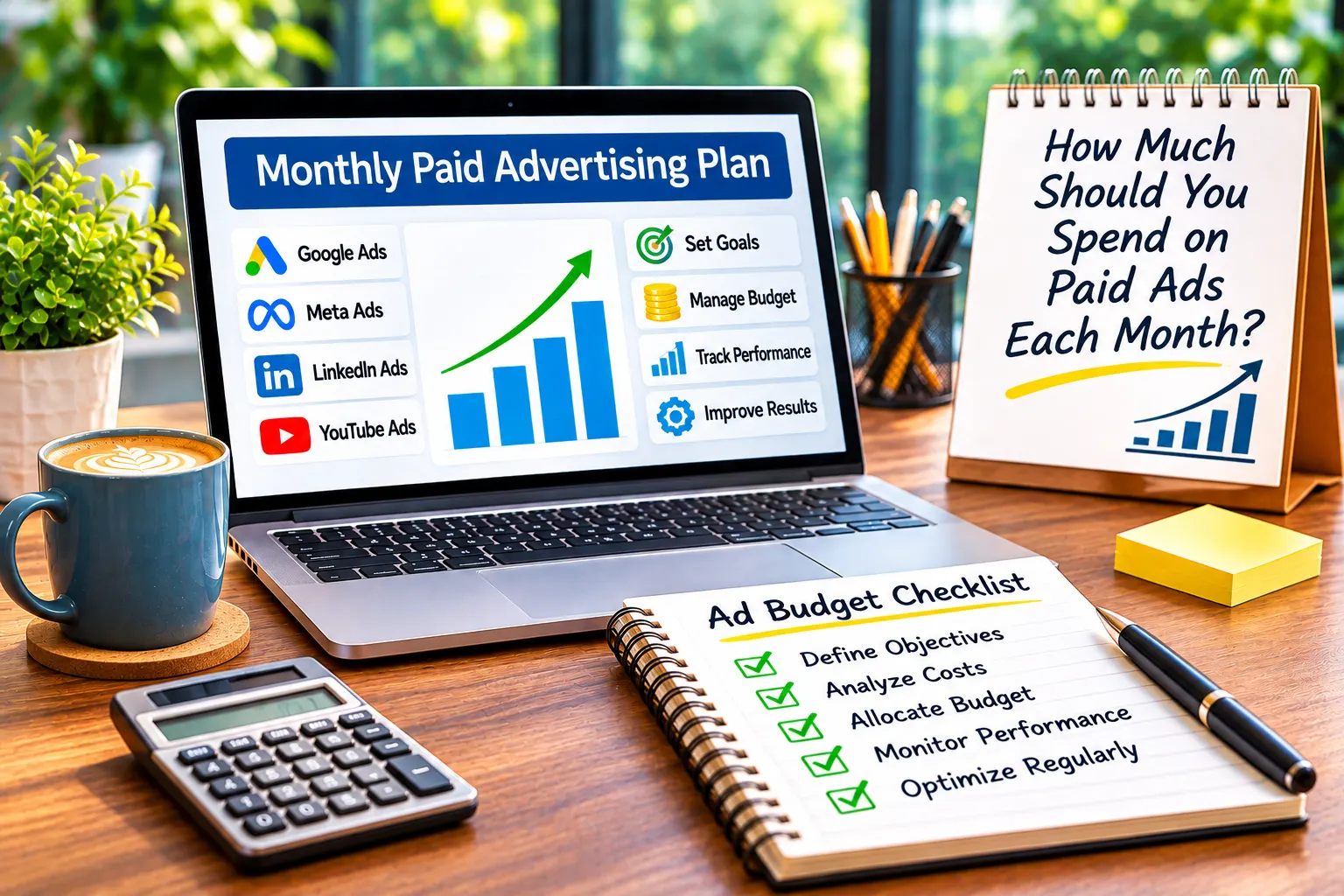
Paid advertising can help businesses generate leads, attract customers, and increase sales. However, one question often comes up before launching a campaign: How much should you spend on paid ads each month?
Should you start with $500, invest $2,000, or commit $10,000 to digital advertising?
The answer depends on your business goals, industry, target audience, competition, and expected return on investment.
Some businesses generate meaningful results with relatively small advertising budgets, while others require significantly larger investments to compete in their markets.
The challenge is not simply determining how much money to spend. It is understanding how to allocate your advertising budget effectively without wasting resources on campaigns that fail to deliver measurable results.
In this guide, we will explain how to calculate your monthly advertising budget, understand platform costs, and develop a paid advertising strategy that supports sustainable business growth.
How Much Should You Spend on Paid Ads Each Month?
Most businesses should determine their monthly paid advertising budget based on customer acquisition goals, expected cost per acquisition, and available marketing resources rather than following a fixed spending percentage.
For example, a small business testing paid advertising might begin with 500–1,500 per month, while a growing business could invest 2,000–5,000 or more.
These are illustrative planning ranges, not universal industry benchmarks or guaranteed minimums.
| Business Stage | Illustrative Monthly Ad Budget | Primary Objective |
| Startup or small local business | 500–1,500 | Test campaigns and generate initial leads |
| Growing small business | 1,500–5,000 | Generate consistent leads |
| Established business | 5,000–10,000 | Expand customer acquisition |
| Scaling business | $10,000+ | Increase reach and sales volume |
Your ideal budget may fall outside these ranges.
For example, a business operating in a competitive legal or financial services market may need a larger budget than a local company targeting a narrow geographic area.
The most important consideration is whether your advertising investment can produce customers at an economically sustainable cost.
Why Your Monthly Paid Advertising Budget Matters
A properly planned advertising budget helps businesses control spending while gathering enough performance data to make informed decisions.
Without a clear budget, businesses may experience several problems:
- Spending too much before identifying effective campaigns
- Running advertisements without clear conversion goals
- Targeting audiences that are unlikely to become customers
- Stopping campaigns before collecting meaningful data
- Increasing spending without improving profitability
- Focusing on clicks rather than qualified leads or sales
A structured paid advertising strategy connects every advertising dollar to a measurable business objective.
For example, generating 100 website visits may sound promising. However, if none of those visitors becomes a customer, the campaign may not contribute to business growth.
Conversely, a campaign generating only 30 visitors could be more valuable if several become paying customers.
This is why advertising budgets should be evaluated using conversion rates, customer acquisition costs, and revenue—not traffic alone.
6 Factors That Determine How Much You Should Spend on Paid Ads
1. Your Business Goals
Your advertising objectives directly influence your budget.
Are you trying to increase website traffic, generate leads, promote a new service, or drive online purchases?
Different objectives require different strategies.
For example, a company seeking brand awareness may prioritize reach and impressions, while a service-based business may focus on qualified inquiries and booked consultations.
Before setting your budget, establish measurable goals such as:
- Generate 40 qualified leads monthly
- Acquire 15 new customers
- Increase online purchases
- Reduce customer acquisition costs
- Improve return on advertising spend
Clear objectives make it easier to estimate the investment required.
2. Your Industry and Competition
Advertising costs vary considerably across industries.
Businesses competing for high-value keywords may face higher costs per click than companies targeting less competitive searches.
For example, keywords related to legal services, insurance, and financial products can be expensive because advertisers may earn substantial revenue from each new customer.
Meanwhile, niche businesses targeting specialized audiences may encounter lower competition.
However, lower advertising costs do not automatically translate into better results.
You must also consider the quality of traffic and the likelihood of conversion.
3. Your Target Audience
A broad audience may require more spending to identify potential customers.
A narrowly defined audience can sometimes improve advertising efficiency, especially when your business serves a specific location or customer segment.
For example, a local physiotherapy clinic may focus its advertising on people searching for treatment within a particular service area.
A national e-commerce brand may need to reach customers across multiple regions.
Geographic targeting, customer demographics, purchasing behavior, and search intent all influence your monthly advertising budget.
4. Your Advertising Platform
Different platforms serve different marketing objectives.
Google Ads can reach people actively searching for products or services.
Facebook and Instagram advertising can help businesses introduce products, build awareness, and reach audiences based on interests and behaviors.
LinkedIn Ads may be useful for reaching business decision-makers, while YouTube advertising can support video-based awareness campaigns.
Choosing the right platform is often more important than distributing your budget equally across every available channel.
5. Your Website Conversion Rate
Your website plays a significant role in advertising profitability.
Suppose your campaign generates 1,000 visitors.
If your website converts 1% of those visitors, you receive 10 conversions.
If improvements to the landing page increase the conversion rate to 3%, the same traffic produces 30 conversions.
This means businesses can sometimes improve advertising performance without increasing their budgets.
Clear messaging, fast-loading pages, relevant offers, and straightforward contact forms can improve the experience for potential customers.
6. Your Customer Lifetime Value
Customer lifetime value estimates the revenue or contribution a customer generates throughout their relationship with your business.
A company earning $100 from a one-time purchase has different acquisition economics from a business generating recurring revenue over several years.
Businesses with higher customer lifetime value may be able to justify higher acquisition costs.
However, advertising decisions should account for profit margins, retention, operating expenses, and cash flow—not revenue alone.
How to Calculate Your Monthly Paid Advertising Budget
Instead of choosing an arbitrary amount, calculate your advertising budget using your customer acquisition targets.
Step 1: Determine Your Customer Goal
Suppose your business wants to acquire 20 new customers per month.
Step 2: Estimate Your Lead-to-Customer Conversion Rate
Assume 20% of qualified leads become customers.
To acquire 20 customers, you need approximately 100 qualified leads.
Step 3: Estimate Your Cost Per Lead
Suppose your expected cost per qualified lead is $25.
Your estimated advertising budget becomes:
100 leads × $25 = $2,500 per month
Alternatively:
Monthly Ad Budget = Target Customers × Expected Customer Acquisition Cost
If your expected advertising cost per acquired customer is $125:
20 customers × $125 = $2,500
Both methods produce the same estimated budget under these assumptions.
Actual results may vary, particularly during early campaign testing.
Step 4: Evaluate Profitability
Before committing to the budget, determine whether acquiring customers at that cost is financially sustainable.
Consider gross profit, repeat purchases, service delivery costs, and any additional agency or creative expenses.
This ensures your advertising strategy supports profitability rather than simply generating activity.
Google Ads vs. Facebook Ads: Where Should You Spend?
Choosing between Google Ads and Facebook or Instagram Ads depends on your target audience and business objectives.
| Factor | Google Ads | Facebook & Instagram Ads |
| Primary strength | Capture existing search demand | Generate interest and demand |
| Audience targeting | Search intent and other targeting signals | Interests, behaviors, and audience signals |
| Common objectives | Leads, inquiries, purchases | Awareness, leads, purchases |
| Creative formats | Search, display, shopping, video | Images, videos, carousels |
| Suitable businesses | Local services, B2B, e-commerce | Consumer brands, local businesses, e-commerce |
For businesses offering services people actively search for, Google Search campaigns may be a logical starting point.
For visually appealing products or services requiring audience education, Meta advertising may offer useful opportunities.
Many businesses eventually benefit from combining platforms, but spreading a small budget across too many campaigns can limit learning.
Start with the channel most closely aligned with your customer’s buying journey.
How to Allocate Your Monthly Advertising Budget
A practical advertising budget should support both customer acquisition and campaign improvement.
For illustration, a business with a $3,000 monthly advertising budget could consider the following allocation:
| Advertising Activity | Budget | Percentage |
| Primary customer acquisition campaigns | $1,800 | 60% |
| Secondary campaign or audience testing | $750 | 25% |
| Remarketing campaigns | $450 | 15% |
| Total | $3,000 | 100% |
This allocation is an example, not a universal formula.
Businesses without a sufficiently large remarketing audience may need to allocate that portion elsewhere.
Similarly, companies launching their first campaigns may need to dedicate more resources to testing before identifying reliable acquisition channels.
Common Paid Advertising Budget Mistakes to Avoid
Even businesses with substantial advertising budgets can struggle when campaigns are poorly managed.
Spending Without Conversion Tracking
If you cannot measure leads, purchases, or other meaningful conversions, you cannot reliably determine whether your advertising is working.
Increasing Budgets Too Quickly
Rapid spending increases can expose businesses to additional costs before campaign performance is understood.
Scale budgets based on reliable conversion data and sustainable acquisition economics.
Ignoring Landing Page Performance
Advertisements may generate relevant traffic, but confusing landing pages can prevent visitors from taking action.
Targeting Too Many Audiences
Spreading a limited budget across numerous campaigns can make it difficult to collect useful performance data.
Focusing Only on Cost Per Click
Cheap clicks are not necessarily profitable clicks.
A higher-cost visitor who becomes a paying customer may be more valuable than multiple inexpensive visitors who never convert.
Expecting Immediate Profitability
New campaigns often require testing, optimization, and adjustments.
Businesses should establish a reasonable testing period and define acceptable performance thresholds before launching.
How to Know Whether Your Paid Ads Budget Is Working
Monitor the metrics that connect advertising performance to business outcomes.
- Cost Per Click (CPC): The average amount paid for an advertising click.
- Cost Per Lead (CPL): Advertising expenditure divided by leads generated.
- Cost Per Acquisition (CPA): Advertising expenditure divided by acquired customers or another defined acquisition action.
- Conversion Rate: The percentage of visitors who complete a desired action.
- Return on Ad Spend (ROAS): Revenue attributed to advertising divided by advertising expenditure.
- Customer Lifetime Value (CLV): The estimated value of a customer throughout the relationship.
These metrics should be evaluated together.
For example, a campaign with strong ROAS may still produce insufficient profit if product margins are low.
Similarly, a campaign with expensive leads may remain profitable when customers generate significant long-term value.
How Caprus Inc. Can Help You Manage Your Paid Advertising Budget
Determining how much to spend on advertising is only the beginning.
Businesses also need a strategy for reaching the right audiences, measuring conversions, improving campaigns, and connecting advertising performance to growth objectives.
At Caprus Inc., we focus on helping businesses approach digital marketing with structured planning, measurable objectives, and performance-driven execution.
Our digital marketing services encompass paid advertising, search engine optimization, content marketing, social media marketing, analytics, and conversion optimization.
Rather than viewing advertising as an isolated activity, we believe it should support your broader customer acquisition and business growth strategy.
Whether you are preparing to launch your first campaign or reviewing an existing advertising budget, understanding your goals, acquisition costs, and conversion opportunities is essential.
Explore our Digital Marketing Services to learn more about building a coordinated marketing strategy.
Final Thoughts: Spend Smarter, Not Simply More
So, how much should you spend on paid ads each month?
There is no single budget that works for every business.
A small company may begin with a modest testing budget, while an established organization may invest thousands of dollars monthly to support customer acquisition.
What matters most is how effectively that investment contributes to measurable business outcomes.
Start with clear goals, estimate your acquisition costs, select appropriate platforms, and monitor conversion performance.
Most importantly, avoid increasing advertising spending simply because competitors appear to be investing more.
The right paid advertising budget is one your business can afford, measure, optimize, and eventually scale profitably.
If you need help developing a structured digital marketing strategy, connect with Caprus Inc. and explore how a performance-focused approach can support your business growth.
FAQs
How much should a small business spend on paid ads each month?
A small business might begin with an illustrative testing budget of 500–1,500 monthly. However, the appropriate amount depends on industry competition, advertising platform, conversion costs, and business objectives. Some markets require substantially more spending to generate meaningful results.
Is $500 per month enough for Google Ads?
A $500 monthly Google Ads budget may be enough to test a narrowly targeted campaign in certain markets. However, highly competitive keywords and expensive customer acquisition costs can limit the number of clicks and conversions available at that spending level.
How do I calculate my monthly advertising budget?
Multiply your target number of customers by your estimated advertising cost per acquired customer. Alternatively, multiply your required number of qualified leads by your expected cost per lead. Evaluate the resulting budget against your profit margins and available resources.
Should I spend more on Google Ads or Facebook Ads?
Google Ads may be preferable when customers actively search for your products or services. Facebook and Instagram Ads may be useful for generating interest, introducing products, and reaching targeted audiences. The best choice depends on your customer journey and campaign goals.
What percentage of revenue should go toward paid advertising?
There is no universally correct percentage. Advertising expenditure should reflect your growth objectives, profitability, cash flow, customer acquisition costs, and overall marketing strategy. Revenue-based percentages can provide planning context but should not replace profitability calculations.
How long should I test paid advertising before increasing my budget?
The testing period depends on conversion volume, sales cycle length, platform learning, and campaign performance. Rather than following a fixed number of days, increase spending when you have sufficient reliable data showing that additional investment is likely to remain economically sustainable.
What is a good return on ad spend?
A good ROAS depends on your business’s margins and operating costs. For example, a 4:1 ROAS means generating $4 in attributed revenue for every $1 spent on advertising. However, that ratio does not automatically guarantee profitability.
Can Caprus Inc. help businesses improve paid advertising performance?
Caprus Inc. offers digital marketing services that include paid advertising, analytics, reporting, SEO, and conversion optimization. Businesses can explore these services to develop more structured campaigns, evaluate performance, and align advertising decisions with broader growth objectives.