
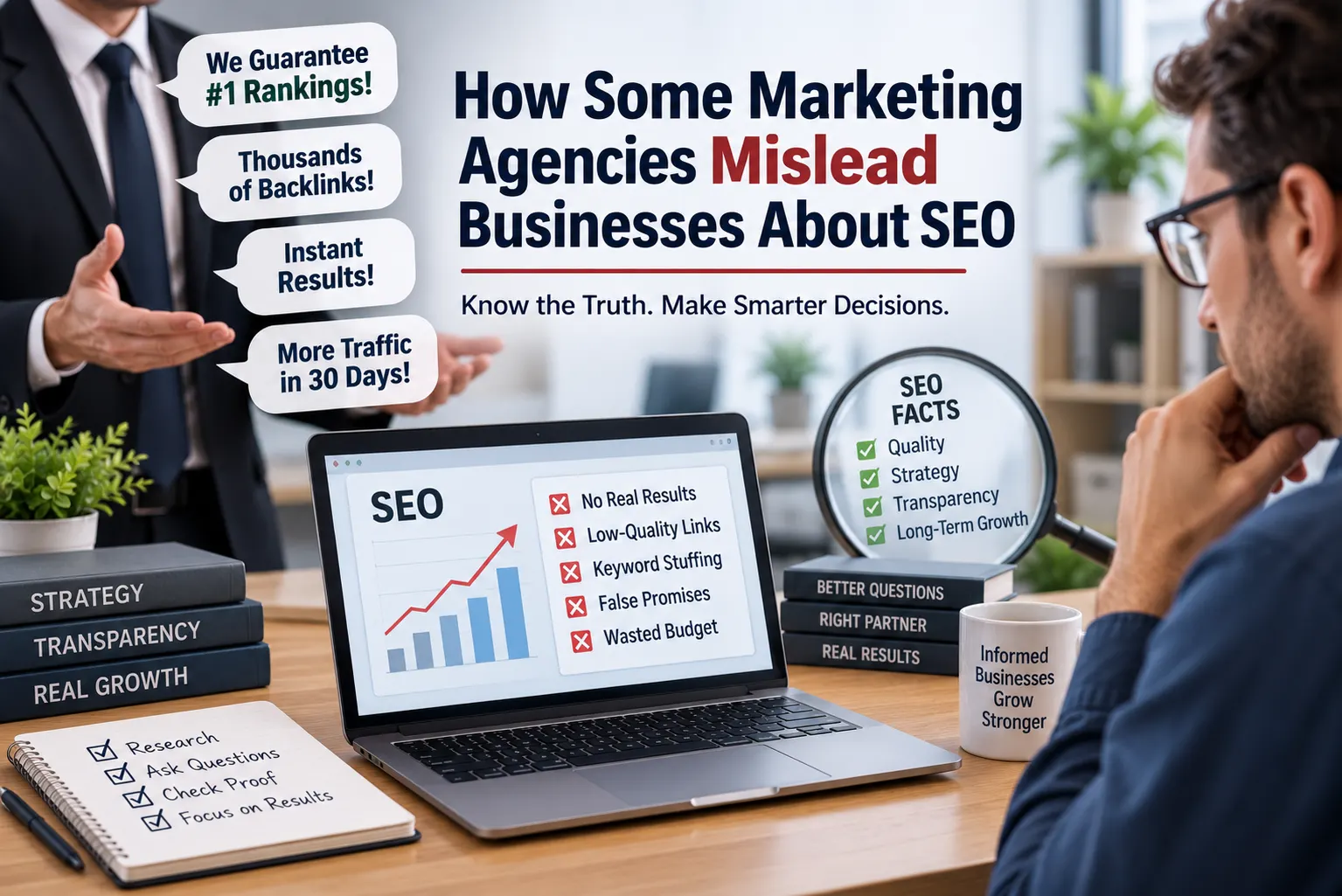
Search engine optimization (SEO) can be one of the most valuable long-term marketing investments for a business. Strong SEO can increase organic visibility, attract qualified prospects, build brand authority, and create a sustainable source of website traffic and leads.
But there is a problem: not every SEO provider approaches SEO responsibly.
Some businesses discover this only after spending months paying an agency that promised first-page rankings, thousands of backlinks, instant traffic growth, or guaranteed results—without receiving meaningful business outcomes.
This is one reason marketing agencies mislead businesses about SEO has become an important conversation for business owners and leadership teams.
The issue is not that marketing agencies are inherently unreliable. Many SEO professionals do excellent work. The problem is that SEO can be complicated, difficult to evaluate from the outside, and dependent on factors that no agency completely controls.
That creates opportunities for misleading sales pitches.
At Caprus, SEO is treated as part of a broader digital marketing and growth framework—not simply as a collection of keywords, backlinks, and rankings. The objective is to connect search visibility with measurable business outcomes.
Here are some of the most common ways businesses can be misled about SEO—and what to look for instead.
1. “We Guarantee First-Page Rankings”
One of the biggest SEO red flags is a guarantee that your website will reach a specific Google ranking within a specific timeframe.
For example:
“We guarantee #1 rankings in 90 days.”
The problem is that an SEO agency does not control Google’s ranking systems.
Search rankings can be influenced by competition, search intent, website quality, technical factors, content relevance, authority, user behavior, algorithmic changes, and many other variables.
A responsible SEO provider should therefore avoid making unrealistic guarantees.
Instead of promising a specific ranking position, an agency should explain:
- What opportunities exist
- Which keywords are realistic targets
- What competitors are doing
- What technical problems need to be addressed
- What content needs to be created or improved
- How authority will be developed
- Which business outcomes will be measured
A good SEO strategy focuses on improving the conditions that support sustainable visibility, rather than pretending that rankings can be controlled like a paid advertising campaign.
2. They Focus on Rankings Instead of Business Results
Rankings matter—but rankings alone don’t pay your bills.
Imagine an agency reports that your website moved from position 58 to position 17 for several keywords.
That sounds impressive.
But what if those keywords generate almost no searches, attract people who aren’t your customers, or produce no leads?
The business may have improved its SEO metrics without improving its business performance.
This is why SEO reporting should go beyond keyword positions.
Businesses should also look at metrics such as:
- Organic traffic
- Qualified organic traffic
- Leads and inquiries
- Conversion rates
- Revenue attributed to organic search
- High-value landing page performance
- Search visibility
- Engagement and user behavior
- New keyword opportunities
The right question isn’t simply:
“Did our rankings improve?”
It is:
“Is organic search becoming a better source of qualified business opportunities?”
3. They Sell Thousands of Backlinks as an SEO Strategy
Another common tactic is selling a specific number of backlinks as though quantity automatically equals SEO success.
“500 backlinks per month” may sound better than “50 backlinks.”
But SEO doesn’t work that way.
Low-quality, irrelevant, automated, or manipulative links can create risks rather than meaningful authority.
Google’s current spam policies specifically identify practices such as buying or selling links for ranking purposes, automated link creation, excessive link exchanges, and low-quality link schemes as examples of link spam.
A credible SEO strategy should focus on relevance, quality, authority, and natural acquisition, rather than treating backlinks as a monthly quota.
Ask an SEO agency:
- Where will the links come from?
- Are the websites relevant to your industry?
- How are websites selected?
- Are links editorially earned or artificially placed?
- Will you receive a report showing the actual referring domains?
- What happens if the agency stops working with you?
If the answer is simply “We have a network that guarantees hundreds of links,” proceed carefully.
4. They Use Keyword Stuffing and Artificial Content
Some agencies still approach SEO as if repeating a keyword as many times as possible will automatically improve rankings.
It won’t.
For example, a poorly written page might repeatedly use phrases such as:
“best SEO company,” “best SEO company near me,” “professional SEO company,” “SEO services,” and “affordable SEO company”
until the content becomes unnatural.
Google explicitly identifies keyword stuffing as a spam practice when keywords are placed unnaturally or excessively to manipulate rankings.
Modern SEO requires content that satisfies the user’s underlying intent.
That means answering questions clearly, demonstrating expertise, providing useful information, and creating a good experience.
The keyword should support the content—not dictate every sentence.
5. They Produce Large Volumes of Low-Value AI Content
AI can be useful in content production. But using AI to automatically produce hundreds of pages without meaningful editorial oversight is another warning sign.
Google’s current spam guidance states that scaled content abuse can include generating large numbers of pages primarily to manipulate search rankings rather than help users. This can apply regardless of whether the content was generated using AI or another method.
That distinction is important.
AI itself isn’t the problem.
The problem is publishing content that:
- Adds little original value
- Repeats information already available elsewhere
- Targets countless variations of the same keyword
- Contains factual or contextual errors
- Exists primarily for search engines rather than readers
A strong content strategy uses technology to improve efficiency while maintaining human oversight, subject-matter relevance, originality, and usefulness.
6. They Hide Behind “SEO Complexity”
SEO is complicated—but that doesn’t mean your SEO provider should be impossible to understand.
If a business owner asks:
“What did you actually do this month?”
and receives a 40-page report filled with technical terminology but no clear explanation, there is a transparency problem.
A good agency should be able to explain SEO in business terms.
For example:
- Problem: Important service pages aren’t being discovered effectively.
- Action: Improved internal linking, page structure, metadata, and supporting content.
- Expected impact: Better topical relevance and stronger pathways for users and search engines.
- Measurement: Organic visibility, relevant keyword movement, organic landing-page traffic, and conversions.
Technical SEO can be complicated behind the scenes. Reporting to the client shouldn’t be unnecessarily complicated.
7. They Report Vanity Metrics
Another way marketing agencies mislead businesses about SEO is by emphasizing impressive-looking numbers that have little connection to revenue.
Examples include:
- Total impressions
- Number of keywords ranking
- Total backlinks
- Website sessions without context
- Pageviews
- Domain metrics from third-party tools
These metrics aren’t necessarily useless.
The problem occurs when they’re presented as proof of success without connecting them to business objectives.
For example, doubling impressions doesn’t necessarily mean doubling customers.
A better SEO report should distinguish between:
Visibility → Traffic → Engagement → Leads → Customers → Revenue
That makes it easier for leadership teams to determine whether SEO is actually contributing to growth.
8. They Don’t Explain What Happens After the Contract Ends
Before signing an SEO contract, ask an important question:
“What happens to the work if we stop working together?”
Businesses should understand who owns:
- Website content
- Blog articles
- SEO research
- Metadata
- Landing pages
- Digital assets
- Analytics accounts
- Search Console access
- Backlink documentation
Your SEO provider should not make your business permanently dependent on them simply because they performed basic optimization work.
A professional relationship should be based on ongoing value—not artificial lock-in.
9. They Promise Immediate SEO Results
SEO can produce improvements at different speeds depending on the website, market, competition, authority, technical condition, content quality, and strategy.
That means a promise such as:
“You’ll get hundreds of leads next month from SEO”
should immediately raise questions.
SEO is generally a long-term growth channel. Some technical improvements can produce relatively quick benefits, while competitive keywords and authority-building initiatives may take considerably longer.
A responsible agency should provide realistic expectations and measurable milestones, rather than selling certainty.
10. They Don’t Conduct a Proper SEO Audit First
Another red flag is an agency that recommends the same SEO package to every business.
Every website has different:
- Technical issues
- Competitive pressures
- Content gaps
- Search intent
- Customer journeys
- Conversion problems
- Authority levels
- Business priorities
Before recommending an SEO strategy, an agency should understand the business and diagnose the website.
A useful SEO assessment can examine:
Technical SEO
Crawlability, indexability, site architecture, page experience, mobile usability, redirects, canonicalization, structured data, and other technical factors.
On-Page SEO
Titles, headings, content structure, internal linking, search intent, topical relevance, and conversion pathways.
Content
Existing content quality, content gaps, topical authority, opportunities, and outdated pages.
Off-Page SEO
Backlink quality, authority, digital PR opportunities, citations, and relevant external signals.
Competitive Landscape
Competitor visibility, content strategies, keyword gaps, SERP features, and market opportunities.
Business Performance
Organic leads, conversions, customer value, revenue opportunities, and other meaningful KPIs.
Only after understanding these factors can an SEO strategy be properly prioritized.
How to Identify a Trustworthy SEO Agency
Choosing an SEO partner doesn’t have to be complicated.
Look for an agency that:
- Explains SEO Clearly: If the agency cannot explain its strategy in plain business language, you should be cautious.
- Provides Transparent Reporting: You should know what was done, why it was done, what changed, and what happens next.
- Avoids Unrealistic Guarantees: No legitimate agency can guarantee Google’s exact ranking positions.
- Connects SEO to Business Objectives: SEO should ultimately support visibility, qualified traffic, leads, customers, and growth.
- Uses Sustainable Practices: The strategy should prioritize valuable content, technical quality, relevant authority, user experience, and search-engine-compliant practices.
- Customizes the Strategy: Your SEO plan should reflect your business, market, competitors, customers, and growth objectives.
What Businesses Should Ask Before Hiring an SEO Agency
Before signing a contract, ask these questions:
- What SEO problems have you identified on our website?
- Which opportunities would you prioritize first?
- How will you measure success?
- Which KPIs will appear in our monthly reports?
- How do you approach link building?
- How do you create and evaluate SEO content?
- Do we retain ownership of the work?
- How frequently will we communicate?
- What happens if Google’s algorithms change?
- What results should we realistically expect?
The answers can reveal more than a polished sales presentation.
SEO Should Be About Sustainable Growth
The biggest lesson is simple:
SEO isn’t about finding a shortcut to Google. It’s about building a website and digital presence that deserves visibility.
Businesses should be skeptical of agencies selling guaranteed rankings, massive backlink quantities, instant traffic, automated content at scale, or impressive reports that don’t connect to revenue.
Google’s search spam policies are designed to address tactics intended to manipulate search visibility, including keyword stuffing, link spam, cloaking, doorway abuse, and scaled low-value content.
That makes sustainable SEO more important than ever.
At Caprus, digital marketing is positioned as an execution pillar within a broader growth framework. Its SEO capabilities include on-page optimization, technical SEO, off-page authority building, local SEO, and content—while the broader approach emphasizes measurable outcomes rather than activity for activity’s sake.
That distinction matters.
The objective shouldn’t be to produce an impressive SEO activity report.
The objective should be to create a search strategy that supports the business.
If your current SEO provider talks primarily about rankings, backlinks, keyword counts, and monthly deliverables—but struggles to explain how those activities contribute to qualified demand and growth—it may be time to reassess the relationship.
Don’t hire an SEO vendor simply because they promise more activity. Choose a growth partner that can explain the strategy, measure the outcomes, and take responsibility for execution.
If your business needs a more structured approach to SEO and digital marketing, Caprus can help assess your current position, identify growth opportunities, and build a strategy aligned with your business objectives.
Explore Caprus Digital Marketing & SEO Services
FAQs
How do marketing agencies mislead businesses about SEO?
Some agencies mislead businesses by promising guaranteed rankings, immediate results, large numbers of backlinks, or dramatic traffic increases without explaining the underlying strategy or limitations. Others focus heavily on vanity metrics instead of qualified leads, conversions, and revenue.
Can an SEO agency guarantee Google rankings?
A trustworthy SEO agency should not guarantee a specific Google ranking position. Search rankings depend on numerous factors outside an agency’s direct control, including competition, search intent, website quality, and changes to Google’s systems.
Is buying backlinks a good SEO strategy?
Buying links specifically to manipulate search rankings can violate Google’s spam policies. Businesses should focus on earning relevant, authoritative links and building genuine value rather than purchasing large quantities of low-quality links.
How can I tell if an SEO agency is legitimate?
Look for transparency, realistic expectations, clear reporting, sustainable SEO practices, measurable KPIs, and a strategy customized to your business. Be cautious of agencies that guarantee rankings or refuse to explain exactly what they’re doing.
What should an SEO agency report every month?
A useful report should show meaningful changes in organic visibility, relevant rankings, organic traffic, landing-page performance, conversions, leads, technical improvements, content activity, and other KPIs connected to business goals.
Is AI-generated content bad for SEO?
AI-generated content isn’t automatically bad for SEO. The problem is producing large volumes of low-value, unoriginal content primarily to manipulate search rankings. Google’s spam policies specifically address scaled content abuse.
How long does SEO take to produce results?
There is no universal timeline. Results depend on the website’s existing authority, technical condition, competition, content quality, industry, search demand, and implementation. A credible agency should provide realistic milestones rather than promise instant results.