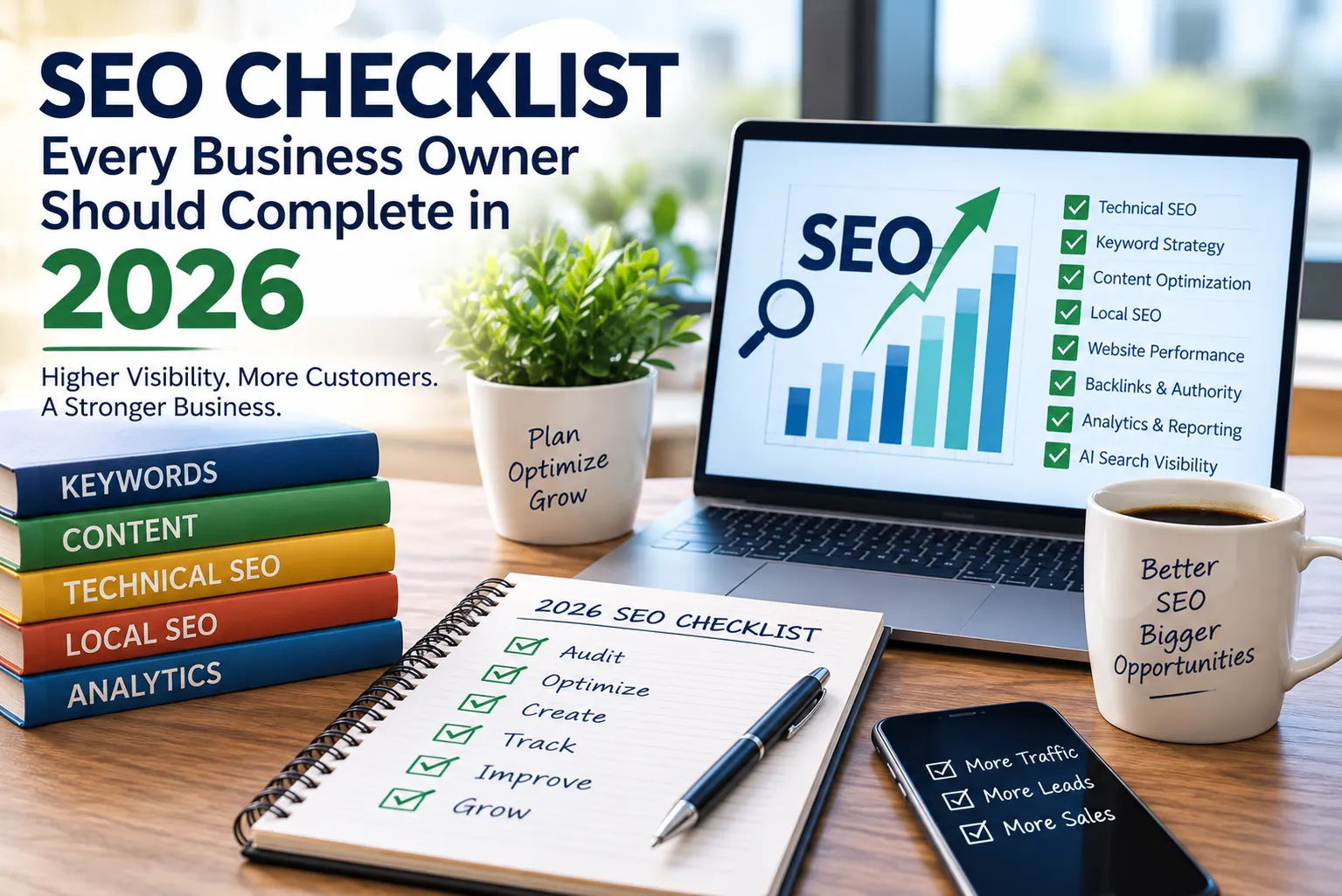
SEO has changed significantly. In 2026, simply publishing blog posts and adding keywords to your website is no longer enough. Businesses need a complete SEO strategy that covers technical performance, search intent, useful content, local visibility, website experience, authority, conversions, and visibility across Google’s evolving AI-powered search experiences.
Google’s current guidance continues to emphasize technical accessibility, helpful and reliable people-first content, crawlability, structured data, and overall page experience. Google also states that the same foundational SEO practices remain relevant for AI Overviews and AI Mode.
That’s why every business owner should work through a structured SEO Checklist at least once a year—and ideally monitor the most important items throughout the year.
Whether you operate a local business, professional service company, e-commerce store, startup, or B2B organization, this 2026 SEO checklist can help you identify the areas that need attention.
What Is an SEO Checklist?
An SEO checklist is a structured list of tasks used to evaluate and improve a website’s visibility in search engines.
A comprehensive checklist covers more than keywords. It includes:
- Technical SEO
- Keyword research and search intent
- On-page optimization
- Content quality
- Internal linking
- Local SEO
- Structured data
- Website performance
- Backlinks and authority
- Conversion optimization
- Analytics and reporting
- AI search visibility
The goal isn’t simply to achieve higher rankings. A strong SEO strategy should help the right people discover your business, understand your offering, trust your brand, and take the next step.
The 2026 SEO Checklist for Business Owners
1. Set Up Google Search Console and Analytics
Before optimizing your website, make sure you can measure what is happening.
Your first SEO checklist should include:
- Verify your website in Google Search Console.
- Connect Google Analytics 4.
- Submit your XML sitemap.
- Check indexing status.
- Monitor search queries and impressions.
- Track organic clicks and click-through rate.
- Configure important conversion events.
- Monitor sudden changes in organic traffic.
Google describes Search Console as a tool that helps website owners understand how their site performs in Google Search and diagnose search-related issues.
Without reliable measurement, you may spend months optimizing pages without knowing whether your efforts are actually generating business results.
2. Complete a Technical SEO Audit
Technical SEO is the foundation of your website.
If search engines cannot properly crawl, render, or understand your website, excellent content may not perform as expected.
Your technical SEO checklist should include:
- Check robots.txt.
- Check XML sitemap.
- Identify accidental noindex pages.
- Fix broken links.
- Find redirect chains and unnecessary redirects.
- Check canonical tags.
- Identify duplicate pages.
- Fix crawl errors.
- Check HTTPS implementation.
- Check mobile responsiveness.
- Identify orphan pages.
- Review website architecture.
- Make important pages easy to reach through internal links.
Google’s SEO documentation specifically recommends ensuring that search engines can crawl important content and that pages are technically accessible.
Business owner tip: Don’t start by publishing 50 new blogs if your website has technical problems preventing important pages from being discovered or indexed.
3. Improve Core Web Vitals and Page Experience
Your website should be fast, stable, mobile-friendly, and easy to use.
Review:
- Largest Contentful Paint (LCP)
- Interaction to Next Paint (INP)
- Cumulative Layout Shift (CLS)
- Mobile usability
- Page loading performance
- Intrusive pop-ups
- Navigation
- Readability
- Overall user experience
Core Web Vitals are part of Google’s page-experience considerations, although Google makes clear that achieving good scores alone does not guarantee high rankings.
The objective is not to chase a perfect technical score simply because a tool gives you a number. Instead, improve performance where it creates a better experience for potential customers.
4. Review Your Keyword Strategy
Keywords remain important, but keyword research in 2026 should begin with search intent, not keyword volume alone.
For every important service or product, identify:
- Primary keywords
- Secondary keywords
- Long-tail keywords
- Informational searches
- Commercial searches
- Transactional searches
- Local search terms
- Question-based searches
- Problem-based searches
For example, a digital marketing company might target terms such as:
- digital marketing agency
- SEO services
- SEO services for small businesses
- local SEO services
- technical SEO services
- SEO audit services
- digital marketing strategy
Don’t create multiple pages simply because several keywords look similar. Instead, determine whether the searches represent different user needs.
Google’s guidance recommends thinking about the terms your audience actually uses and writing naturally for those users rather than attempting to anticipate every possible keyword variation.
5. Optimize Every Important Page
Your on-page SEO checklist should cover your homepage, service pages, product pages, location pages, and important blog posts.
Check whether each page has:
- A unique SEO title
- A compelling meta description
- One clear H1
- Logical H2 and H3 headings
- A descriptive URL
- Naturally integrated keywords
- Helpful and original content
- Internal links
- Relevant image alt text
- Clear calls to action
- Supporting FAQs where appropriate
Avoid keyword stuffing.
Your content should explain the topic naturally while making it obvious to users—and search engines—what the page is about.
Google’s SEO guidance recommends descriptive titles, useful content, logical organization, descriptive URLs, and content written primarily to help people.
6. Build a People-First Content Strategy
One of the biggest mistakes businesses make is publishing content simply because a keyword has search volume.
Instead, ask:
Does this article solve a real problem for my potential customer?
Your content strategy should include:
- Educational blog posts
- How-to guides
- Comparison articles
- Industry insights
- Frequently asked questions
- Case studies
- Service explainers
- Original research
- Expert commentary
- Location-specific content where relevant
For example, instead of publishing a generic article called “What Is SEO?”, a digital marketing company could create:
“SEO Checklist for Small Businesses: 30 Things to Fix Before Spending More on Ads.”
That’s more closely connected to a business owner’s actual problem.
Google emphasizes original, helpful, reliable, people-first content rather than content created primarily to manipulate search rankings.
7. Strengthen Internal Linking
Internal links help users and search engines discover related content.
For example, a blog about SEO audits could link naturally to your:
- SEO services page
- Technical SEO service
- Content marketing service
- Digital marketing service
- Contact page
Your internal linking checklist should include:
- Link from high-authority pages to important service pages.
- Connect related blog posts.
- Use descriptive anchor text.
- Avoid excessive internal links.
- Identify orphan pages.
- Create topic clusters around important services.
A good internal linking structure also helps demonstrate the relationship between different pieces of content across your website.
8. Complete Your Local SEO Checklist
If your business serves a specific geographic area, local SEO should be part of your 2026 SEO strategy.
Check:
- Google Business Profile
- Business name, address, and phone number
- Business categories
- Service areas
- Business description
- Website URL
- Opening hours
- Photos and videos
- Customer reviews
- Review responses
- Local citations
- Location pages
- Local keywords
- Consistency of business information
Don’t create hundreds of low-quality location pages just to target city names. Each location page should provide genuinely useful information for people in that area.
Google also recommends keeping Business Profile information up to date when considering visibility in its AI-powered search experiences.
9. Add Relevant Structured Data
Structured data gives search engines additional information about the content of a page.
Depending on your business, relevant schema may include:
- Organization
- LocalBusiness
- Service
- Article
- BreadcrumbList
- Product
- FAQPage where applicable
- Person
- WebSite
Structured data should accurately represent visible content on the page.
Google explains that structured data can help it understand page content and may make pages eligible for certain richer search features.
Don’t add schema simply to add schema. Use markup that genuinely describes the page.
10. Optimize for AI-Powered Search
AI-powered search is an important consideration in 2026.
However, businesses shouldn’t treat AI SEO as a replacement for traditional SEO.
Google’s current guidance states that the fundamental SEO practices used for traditional search also apply to AI Overviews and AI Mode. There is no separate “magic” optimization or special AI schema required to appear in these experiences.
To improve your website’s ability to be understood and referenced:
- Answer questions clearly.
- Use descriptive headings.
- Provide concise definitions.
- Explain concepts thoroughly.
- Demonstrate first-hand expertise.
- Support claims with credible sources.
- Include relevant entities and context.
- Keep important information in text.
- Maintain accurate business information.
- Build topical authority.
- Keep valuable content updated.
In other words, good SEO remains the foundation of AI search visibility.
Google also introduced dedicated Search Console reporting for visibility from generative AI features in 2026, giving site owners additional insight into how their content appears across these experiences.
11. Build Website Authority
Ranking isn’t only about what’s on your website.
Your business should also develop authority through legitimate external signals.
Your off-page SEO checklist can include:
- Relevant backlinks
- Industry publications
- Digital PR
- Business directories
- Industry associations
- Partner websites
- Expert interviews
- Original research
- Guest contributions
- Brand mentions
Focus on relevance and credibility rather than purchasing large quantities of low-quality backlinks.
A handful of meaningful industry references can be more valuable for your long-term strategy than hundreds of irrelevant links.
12. Optimize for Conversions
Traffic isn’t the final objective.
A website can receive thousands of visitors and still generate very few leads.
Review:
- Contact forms
- Calls-to-action
- Phone numbers
- Consultation buttons
- Lead forms
- Service-page CTAs
- Navigation
- Trust signals
- Testimonials
- Case studies
- Pricing information where appropriate
Every important landing page should answer three questions quickly:
What do you offer?
Who is it for?
What should I do next?
SEO and conversion optimization should work together.
13. Monitor and Update Your SEO Performance
SEO should never be a “set it and forget it” activity.
Create a monthly SEO review covering:
- Organic traffic
- Impressions
- Clicks
- CTR
- Keyword visibility
- Landing-page performance
- Conversions
- Backlinks
- Indexing issues
- Technical errors
- Content performance
- Local visibility
- AI search visibility where measurable
Every quarter, perform a deeper SEO audit.
Look for pages that are losing traffic, outdated content, declining rankings, technical problems, and opportunities to improve existing pages.
Google’s own guidance recommends using Search Console to monitor performance and diagnose search traffic changes.
Quick 2026 SEO Checklist
Before considering your website SEO-ready, make sure you can check these boxes:
☐ Google Search Console configured
☐ GA4 configured
☐ XML sitemap submitted
☐ Robots.txt reviewed
☐ Important pages indexed
☐ No accidental noindex pages
☐ Broken links fixed
☐ HTTPS enabled
☐ Mobile-friendly website
☐ Core Web Vitals reviewed
☐ Keyword strategy updated
☐ Search intent mapped
☐ Title tags optimized
☐ Meta descriptions optimized
☐ H1-H3 structure reviewed
☐ Internal linking improved
☐ Helpful content published
☐ Outdated content refreshed
☐ Local SEO optimized
☐ Google Business Profile updated
☐ Relevant structured data implemented
☐ Backlink strategy established
☐ Conversion tracking configured
☐ CTAs optimized
☐ Organic performance monitored
☐ AI search visibility considered
Final Thoughts: Make SEO Part of Your Growth Strategy
A successful SEO strategy in 2026 isn’t about checking a few boxes and hoping Google rewards your website.
It’s about creating a technically sound website, publishing genuinely useful content, understanding your customers’ search behavior, building authority, improving user experience, and continuously measuring performance.
And importantly, SEO shouldn’t operate in isolation.
At Caprus Inc., SEO is part of a broader digital marketing and growth framework. Caprus combines SEO, content marketing, paid advertising, social media, analytics, and other business capabilities to connect digital activity with measurable business objectives.
If your website has traffic but isn’t generating enough leads, you’re struggling to rank for important services, or you simply don’t know where your SEO problems are coming from, a structured SEO audit can help identify the highest-priority opportunities.
The first step is simple: audit what you already have before investing more into what you don’t.
FAQs
What is an SEO checklist?
An SEO checklist is a structured list of tasks used to evaluate and improve a website’s search visibility. It typically covers technical SEO, keywords, on-page optimization, content, local SEO, backlinks, structured data, performance, and analytics.
What should be included in an SEO checklist for 2026?
A modern SEO checklist should include technical SEO, keyword research, search intent, on-page SEO, helpful content, internal linking, Core Web Vitals, local SEO, structured data, authority building, conversion optimization, analytics, and preparation for AI-powered search experiences.
How often should a business perform an SEO audit?
Businesses should continuously monitor important SEO metrics and perform a more comprehensive SEO audit at least quarterly. Larger or frequently changing websites may require more frequent technical monitoring.
Is SEO still important with AI search?
Yes. Google states that its AI search features continue to rely on its core Search systems and that existing SEO best practices remain relevant. Businesses should therefore continue investing in technical SEO, helpful content, authority, and strong website experiences.
How long does SEO take to show results?
SEO timelines vary depending on competition, website authority, technical condition, content quality, industry, search demand, and the starting point of the website. SEO should generally be treated as a long-term growth strategy rather than an instant traffic channel.
Can small businesses do SEO themselves?
Yes. Business owners can handle many SEO fundamentals themselves, particularly keyword research, basic on-page optimization, content improvements, Google Business Profile management, and performance monitoring. More complex technical SEO, large-scale content strategies, and competitive markets may benefit from professional support.
What is the most important part of an SEO checklist?
There isn’t one universal task that guarantees rankings. Start with the fundamentals: make sure search engines can access your website, ensure important pages can be indexed, create useful content that satisfies search intent, provide a good user experience, and measure your results consistently.
How can Caprus Inc. help with SEO?
Caprus Inc. provides SEO and digital marketing services as part of a broader growth framework. Its SEO capabilities include on-page optimization, technical SEO, off-page SEO, local SEO, and content marketing, alongside other digital marketing and growth services.