
You don’t always notice when your social media strategy is failing.
There may be no dramatic drop in sales. No angry customers. No obvious warning that something is wrong.
Instead, the damage happens quietly.
A potential customer discovers your business on Instagram, visits your profile, sees that your last post was three weeks ago, then checks LinkedIn and finds completely different messaging. Your website says one thing. Your social channels say another. Some weeks, you publish five posts. The next month, you disappear.
The customer may never tell you why they decided not to contact you.
They simply move on.
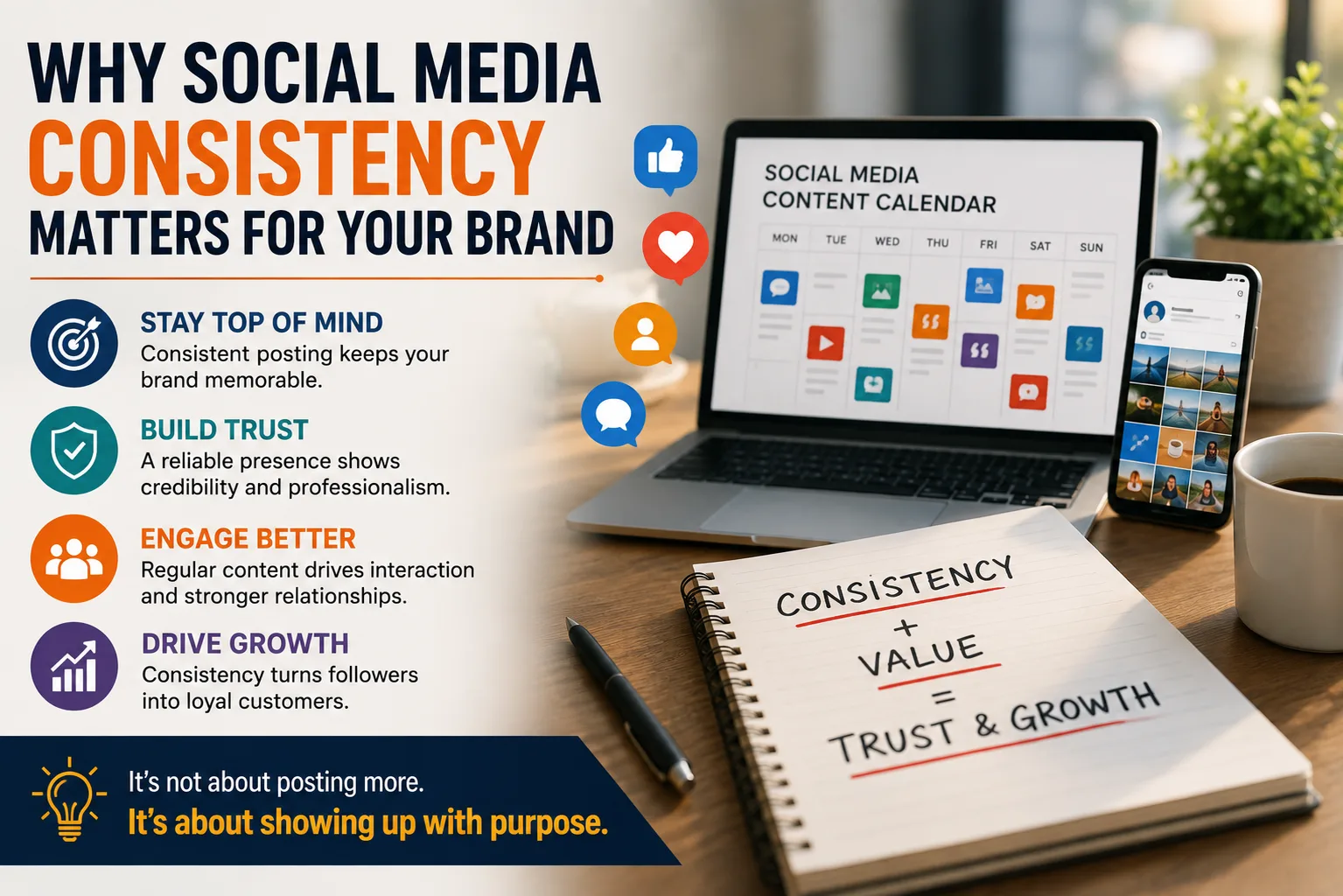
This is why Social Media Consistency is more important than simply “being active” online. Consistency helps customers recognize your brand, understand what you offer, and develop confidence in your business over time.
Research and industry analysis increasingly point toward the importance of consistent, authentic communication in building trust. Inconsistent messaging can reduce perceived credibility, while consistent communication helps reinforce brand identity and expectations.
For businesses trying to compete in a crowded digital marketplace, inconsistent social media can become an invisible growth problem.
What Does Social Media Consistency Actually Mean?
Social Media Consistency doesn’t mean posting every single day.
It means showing up with a recognizable strategy.
That includes consistency in:
- Posting frequency
- Brand voice
- Visual identity
- Topics and content pillars
- Audience messaging
- Quality standards
- Calls to action
- Brand positioning
- Engagement with followers
- Overall business objectives
For example, imagine a consulting company that publishes LinkedIn posts about business strategy one week, random motivational quotes the next, memes the following week, and then disappears for a month.
Even if every individual post is well-designed, the overall brand feels disconnected.
Now compare that with a company that consistently publishes practical business insights, customer education, industry perspectives, case studies, and solutions related to its services.
The second company is easier to understand.
And when customers understand a brand, they’re more likely to remember it.
1. Inconsistency Makes Your Brand Easier to Forget
People are exposed to an enormous amount of digital content every day.
Your audience may see your brand today and not need your services until three months from now.
That means your social media has to create familiarity before the buying decision happens.
Consistent communication gives your audience repeated opportunities to encounter your brand.
Think about the brands you remember immediately.
You probably don’t remember them because you saw one post six months ago.
You remember them because you’ve encountered them repeatedly.
That repetition creates familiarity.
When your business disappears for long periods, you lose opportunities to stay mentally available to potential customers.
Social Media Consistency doesn’t guarantee that every post will generate leads. Its bigger role is to make sure your brand remains part of the customer’s consideration set.
2. An Abandoned Profile Can Create the Wrong Impression
Your social media profile is often part of your digital storefront.
Before contacting a business, potential customers may look at its website, Google Business Profile, LinkedIn page, Instagram account, or other social channels.
What happens when they find an account that hasn’t been updated in months?
They may start making assumptions.
Is the business still operating?
Are they active?
Do they still provide this service?
Do they care about their customers?
Is this company trustworthy?
These questions may never be consciously articulated, but they can influence perception.
A neglected social profile doesn’t necessarily mean a business is unsuccessful. But it can create an appearance of inactivity.
That is a problem when competitors are consistently communicating their expertise and staying visible.
3. Inconsistent Messaging Creates Brand Confusion
Posting irregularly isn’t the only problem.
What you say matters just as much as how often you say it.
Imagine your website positions your company as a premium strategic partner, while your social media focuses primarily on discounts and generic promotional messages.
There is a disconnect.
Your audience receives conflicting signals about who you are.
Strong brands create a recognizable connection between their website, social media, advertising, email marketing, and other customer touchpoints.
Research into brand consistency has found that maintaining a coherent brand personality across digital content can support trust and long-term customer relationships.
Your audience shouldn’t have to figure out which version of your business is the “real” one.
Your marketing should make that obvious.
4. You Lose Momentum With Your Audience
Social media relationships are built gradually.
Someone might follow your business without buying anything.
Then they see an educational post.
A few weeks later, they see a customer success story.
Later, they watch a video explaining a problem they are experiencing.
Eventually, they may become a customer.
This process doesn’t always happen through one viral post.
It happens through accumulated exposure.
When you suddenly stop publishing, that relationship loses momentum.
Your audience has thousands of other accounts competing for its attention.
If you disappear, something else fills the space.
This is particularly important for businesses with longer sales cycles, where customers need education and repeated exposure before making a decision.
5. Inconsistency Makes Marketing More Reactive
One of the biggest problems businesses face is creating social media content only when they “have time.”
Monday: “We need a post.”
Tuesday: Someone creates something quickly.
Next week: Nobody has an idea.
Then a promotional campaign starts and suddenly the business needs ten posts immediately.
This reactive approach creates unnecessary pressure and usually produces inconsistent content.
A strategic content calendar changes the process.
Instead of asking:
“What should we post today?”
you can ask:
“What does our audience need to know this month?”
That small change moves social media from random activity to intentional marketing.
6. You’re Probably Undervaluing Non-Promotional Content
Another reason brands become inconsistent is that they think every post needs to sell something.
It doesn’t.
Your audience needs a reason to follow you before they have a reason to buy from you.
That means your content can include:
- Educational insights
- Industry trends
- Frequently asked questions
- Behind-the-scenes content
- Customer stories
- Case studies
- Practical tips
- Expert opinions
- Short videos
- Industry statistics
- Myth-busting content
- Company culture
- Service explanations
This type of content helps establish expertise and gives your audience a reason to continue paying attention.
Caprus approaches social media as part of a broader digital marketing system rather than an isolated activity. Its social media services include content planning, creation and scheduling, platform management, paid social campaigns, and influencer marketing, with messaging and targeting aligned to brand development and lead generation.
That distinction matters.
Social media should support the business—not simply fill a content calendar.
7. Consistency Helps Build Trust
Trust rarely develops from one interaction.
It develops when a company repeatedly demonstrates that its message, behavior, and customer experience align.
Recent research in social media marketing also emphasizes authenticity, transparency, and consistency as important elements of digital brand communication and consumer trust.
When your audience repeatedly sees useful and relevant content from you, your brand becomes more familiar.
Over time, familiarity can reduce uncertainty.
And reduced uncertainty matters when customers are deciding whether to spend their money, share their information, schedule a consultation, or contact your team.
Consistency essentially tells your audience:
“We’re here. We know what we’re doing. And we’re committed to what we do.”
8. Your Competitors Don’t Need Better Marketing—They May Just Be More Consistent
This is one of the hardest truths for businesses to accept.
You may have better services.
You may have more experience.
You may provide better customer service.
But if your competitor consistently communicates its expertise while your brand appears sporadically, customers may perceive the competitor as more established.
Visibility influences perception.
That doesn’t mean you should post meaningless content simply to keep up.
It means your expertise needs a reliable distribution system.
A strong social media strategy allows your business to repeatedly communicate its strongest differentiators.
9. Consistency Doesn’t Mean Posting More
This is an important distinction.
If you currently publish once every few weeks, you don’t necessarily need to jump to three posts per day.
The goal is sustainable consistency.
For one business, that might mean:
3 quality posts per week.
For another:
2 LinkedIn posts + 2 short-form videos per week.
For another:
A weekly educational post, one customer story, and regular video content.
The right frequency depends on your audience, resources, industry, platform, and objectives.
The worst strategy is choosing a publishing schedule that looks impressive for two weeks and becomes impossible to maintain.
Sustainable Social Media Consistency beats short bursts of activity.
10. The Solution Is a System, Not More Motivation
If your social media becomes inactive every time your team gets busy, the problem probably isn’t motivation.
It’s the absence of a system.
A sustainable social media system should include:
Clear Content Pillars
Define the major subjects your brand should consistently discuss.
For example:
- Education
- Expertise
- Customer success
- Industry insights
- Services
- Brand stories
A Content Calendar
Plan content ahead of time instead of creating everything at the last minute.
Platform-Specific Execution
The same core idea can be adapted for LinkedIn, Instagram, Facebook, TikTok, or other channels rather than blindly copying the exact same post everywhere.
Content Templates
Templates reduce production time and help maintain visual consistency.
Scheduling
Batching and scheduling content can prevent gaps when your team becomes busy.
Performance Tracking
Don’t measure success only through likes.
Look at metrics such as:
- Reach
- Engagement
- Profile visits
- Website traffic
- Leads
- Conversions
- Audience growth
- Content saves and shares
The objective is to understand which content contributes to business outcomes.
How Caprus Inc Can Help Build a Consistent Social Media Strategy
Social media management becomes much easier when it is connected to a broader growth strategy.
That’s where Caprus Inc can help.
Caprus Inc works with organizations that want structured growth without unnecessary complexity. Its approach combines strategy, execution, operational discipline, and continuous optimization rather than treating marketing as a collection of disconnected activities.
Through its digital marketing capabilities, Caprus supports social media management alongside SEO, content marketing, paid advertising, email marketing, reputation management, and other growth activities.
That integrated approach is important because your social media shouldn’t operate inside a silo.
Your social content should reinforce your SEO strategy.
Your content should support your sales process.
Your paid campaigns should align with your organic messaging.
Your website should communicate the same positioning as your social profiles.
And your brand should feel recognizable wherever a potential customer encounters it.
Caprus focuses on connecting these activities into structured demand-generation systems designed around visibility, engagement, and conversion.
A Simple Social Media Consistency Checklist
Before you publish your next post, ask:
Is our brand recognizable?
Does the visual style and tone match our overall identity?
Is this content relevant to our audience?
Are we solving a problem, answering a question, or providing useful insight?
Does this support our positioning?
Would someone understand what our business stands for after seeing this?
Are we publishing consistently?
Not just this week—but over the next three months?
Does this connect to a business objective?
Are we trying to build awareness, authority, engagement, traffic, leads, or customer relationships?
If you can’t answer these questions, your social media may need a strategy—not simply more posts.
Final Thoughts: Your Brand Doesn’t Need to Be Everywhere. It Needs to Be Dependable.
Inconsistent social media rarely destroys a brand overnight.
That’s what makes it dangerous.
The damage is gradual.
You become less recognizable.
Your audience forgets you.
Your messaging becomes fragmented.
Your competitors occupy more attention.
Your brand appears less active.
And potential customers quietly choose someone else.
The answer isn’t to chase every trend or publish meaningless content every day.
The answer is Social Media Consistency backed by strategy.
Show up.
Be useful.
Stay recognizable.
Communicate your expertise.
Keep your messaging aligned.
And make your social media part of a larger growth system.
If maintaining that consistency is difficult because your team doesn’t have the time, strategy, or resources to manage it internally, Caprus Inc can help turn your social media from an inconsistent task into a structured component of your growth strategy.
Explore Caprus Inc’s Digital Marketing Services
FAQs
What is Social Media Consistency?
Social Media Consistency means maintaining a reliable approach to publishing, branding, messaging, content quality, and audience engagement. It doesn’t necessarily mean posting every day; it means maintaining a sustainable and recognizable presence.
Why is Social Media Consistency important for a business?
Social Media Consistency helps businesses remain visible, recognizable, and relevant to their target audience. Regular communication can reinforce brand familiarity and help build trust over time.
How often should a business post on social media?
There is no universal posting frequency. A sustainable schedule based on your audience, platform, industry, resources, and marketing goals is generally more effective than publishing large amounts of content for short periods and then disappearing.
Can inconsistent social media hurt brand trust?
Yes. Inconsistent messaging, branding, or communication can create confusion and reduce perceived credibility. Research has found that inconsistencies across different sources of brand-related content can negatively affect perceived content credibility and brand attitudes.
Does Social Media Consistency mean posting the same content everywhere?
No. Your core brand message should remain recognizable, but content should be adapted to the format, audience, and culture of each platform.
What should a business post on social media?
Businesses can combine educational content, industry insights, customer stories, case studies, FAQs, behind-the-scenes content, videos, expert opinions, service information, and promotional content.
How can a business maintain Social Media Consistency?
A content strategy, defined content pillars, editorial calendar, reusable templates, scheduling system, clear brand guidelines, and regular performance analysis can make consistency much easier to maintain.